 StainList
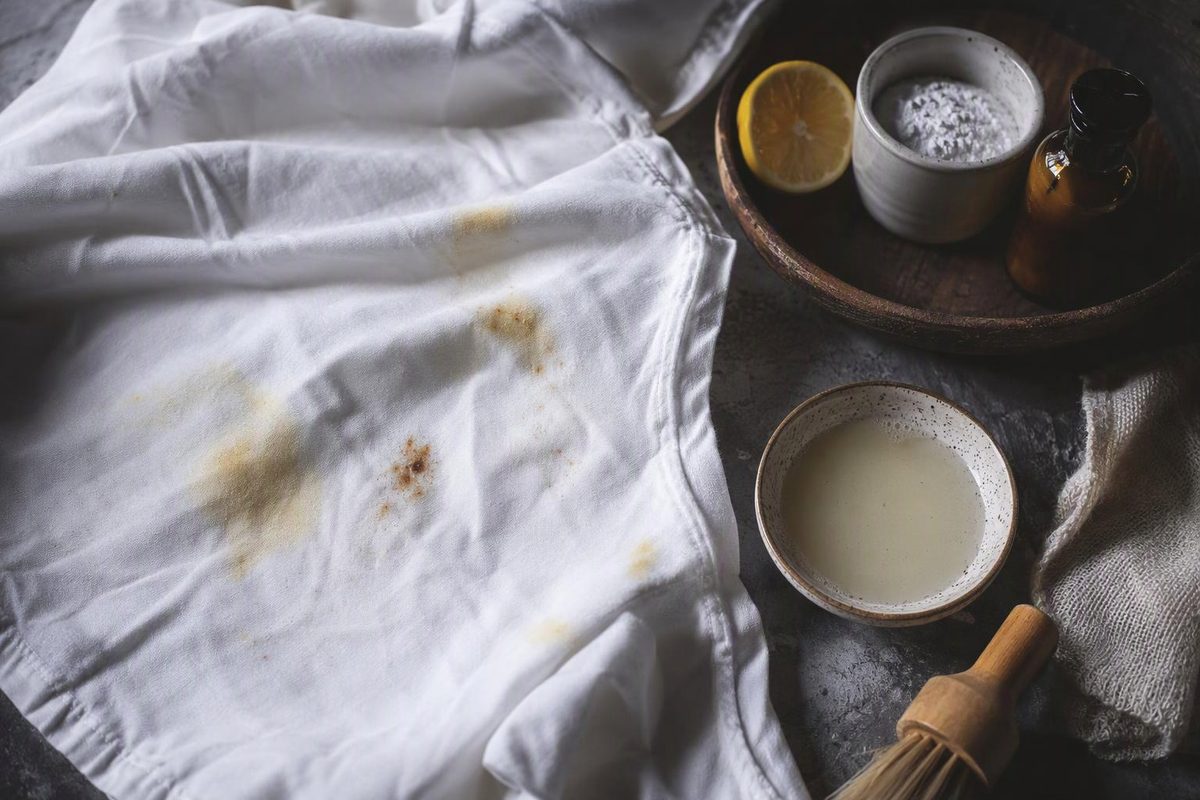
Do not reach for chlorine bleach just because the garment is white. First check the care label and look at the yellowing pattern: underarm marks, oily dots, orange-brown specks and general yellowing call for different treatments. A white fabric may contain wool, silk, spandex, a special finish or trim that chlorine bleach can damage (American Cleaning Institute).
Identify the likely cause
- Underarms, collar or cuffs: suspect perspiration, deodorant and body soil.
- Translucent or greasy dots: suspect food oil, body oil, fabric softener or another laundry product. If spots first appeared after washing, follow the diagnostic steps in 7 Causes of Oily Laundry Spots After Washing.
- Yellow-orange or brown specks: suspect iron or rust, especially if several garments changed in the same load or the home has well water.
- Pale yellow areas after storage: an old food, drink or oily stain may have become visible with age. Sugary spills that once looked clear can oxidize and turn yellow or brown (ACI); oxidized oil can also yellow (Smithsonian Museum Conservation Institute).
- Yellowing after chlorine bleach: this may be fiber damage rather than a removable stain. ACI says chlorine-bleach yellowing on wool, silk or spandex cannot be removed, while the Smithsonian notes that chlorine bleach can eventually yellow and weaken cotton or linen (ACI; Smithsonian).
Start with detergent
Use this least-aggressive sequence for washable cotton, linen and most washable synthetics:
- Read the care label. Take a dry-clean-only garment to a cleaner rather than wet-treating it. If the item has colored trim, stitching or a print, patch-test the treatment on an inside seam.
- Apply liquid laundry detergent to the yellow area. For suspected food or body soil on cotton, linen or a washable synthetic, an enzyme-containing detergent may help; follow its fiber restrictions.
- Work it in gently with your fingers. Avoid brushing fragile, thin or abraded cloth.
- Leave it for the label’s stated pretreatment time. Follow any maximum-time or rinsing instructions.
- Wash at the warmest temperature permitted by the garment label. Inspect while the fabric is still wet. If yellow remains, do not put the item in the dryer; ACI advises repeating treatment before drying (ACI stain-removal guide).
If the mark is lighter but still visible, move to the matching treatment below rather than scrubbing harder.
Sweat, deodorant or old organic stains
After detergent pretreatment, wash or soak with an oxygen bleach labeled safe for the garment. Use the product label’s dose, water temperature and soak time. Dissolve powdered oxygen bleach as directed instead of pouring it onto wet cloth.
ACI recommends liquid detergent for light deodorant stains. For heavy marks, it recommends a prewash treatment for 5–10 minutes followed by laundering with oxygen bleach; stubborn perspiration may also respond to enzymes or oxygen bleach in the hottest water safe for the fabric (ACI).
Rinse thoroughly and inspect before drying. If one treatment clearly lightens the mark without changing the fabric, repeat as directed rather than increasing the concentration.
Oily yellow spots
Pretreat with liquid laundry detergent and wash at the warmest temperature the care label permits. Keep the garment out of the dryer until the spot is gone.
If fresh spots keep appearing, stop treating garments one at a time. Check whether liquid softener is being poured directly onto fabric, whether the washer is overloaded and whether the detergent dose matches its label. ACI identifies undiluted fabric softener and insufficient detergent as causes of greasy laundry spots (ACI).
Rust-colored spots
Do not use chlorine bleach: it can intensify rust discoloration. Patch-test a rust remover specifically labeled for washable fabric, follow its directions, and launder afterward. Both ACI and the University of Georgia recommend a fabric rust remover for brown or yellow rust discoloration (ACI; UGA Extension).
If an entire white load turned yellow-orange, investigate the water supply before washing more whites. ACI lists iron or manganese in water, pipes or a water heater as possible causes. With high-iron well water, chlorine bleach can convert the iron to rust that deposits on clothing (ACI; Clorox).
Stop if the fabric changes
Stop treatment if the area becomes paler than the surrounding cloth, rough, thin, weak or misshapen. Stronger bleach cannot repair damaged fibers.
Never mix chlorine bleach with ammonia or acidic products such as vinegar; the resulting fumes can be dangerous. Use any bleach only when both the garment care label and bleach label permit it (ACI).
Refer an antique, heirloom or fragile textile to a textile conservator. Older fibers lose resistance to rubbing, stretching and tearing, so stain removal can leave a hole where there was only discoloration before (Smithsonian Museum Conservation Institute).