 StainList
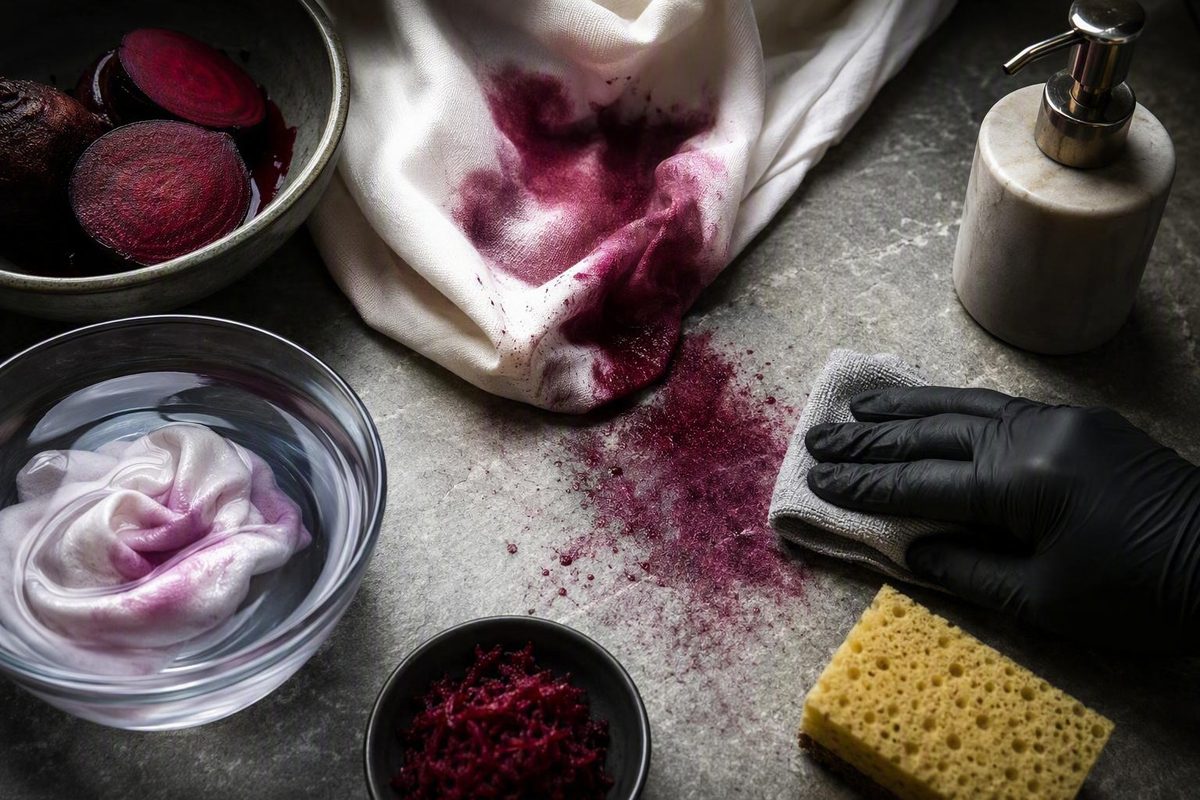
Beet color comes largely from water-soluble betalain pigments, including the red-violet betacyanins found in red beetroot (review in Molecules). That makes water and detergent the sensible first treatment—but the safe next step depends on whether the mark is on washable fabric, carpet, quartz, natural stone or another finish.
Washable clothing and linens
- Lift off beet pieces. Use a spoon or dull edge. Blot juice with a white cloth; do not grind solids into the fibers.
- Flush from the back with cool running water. Hold the unstained side toward the faucet so water pushes pigment back out rather than farther through the fabric.
- Pretreat with liquid laundry detergent. Apply enough to cover the mark, work it in gently with your fingers and leave it for the detergent label’s stated pretreatment time. Tide’s beet-specific guidance likewise starts by absorbing excess liquid, then pretreating with detergent and water before washing (Tide).
- Wash according to the care label. Use the warmest water the label permits, not an automatically hot cycle. The American Cleaning Institute recommends laundering according to the fabric-care instructions and repeating treatment if the stain remains (ACI).
- Air-dry and inspect. Do not tumble-dry until the stain is gone; ACI specifically advises keeping a stained item out of the dryer and repeating the treatment if necessary (ACI).
If a pink shadow remains, soak or rewash with an oxygen bleach labeled safe for that washable fabric, following its exact dilution and soak time. Use chlorine bleach only when both the garment care label and bleach label permit it—typically on suitable white, bleach-safe fabric. “White” alone is not permission: spandex, wool, silk, dyes, prints and finishes can rule it out.
Do not combine vinegar, peroxide, ammonia or chlorine bleach. A stronger mixture is not a better stain treatment, and universal bleaching advice can exchange a beet mark for faded dye or weakened fibers.
Old or already dried beet stains
Rewet the spot with cool water, pretreat with liquid detergent, wash as labeled and air-dry. Repeat once if the color is clearly fading. Set or heat-exposed marks may not disappear completely; escalating through random acids, solvents and bleaches raises the damage risk. The same inspect-before-drying principle applies to other deeply colored food and drink marks; see the red wine stain guide.
Stop home treatment for dry-clean-only garments, silk, wool, antique linens, unstable dyes or decorated textiles. Blot excess, tell the cleaner the stain is beet and identify any treatment already used.
Carpet and rugs
Blot promptly with a dry white absorbent cloth. Patch-test first, then apply a small amount of solution to a white cloth and work from the edge toward the center without rubbing. The Carpet and Rug Institute’s beet-juice procedure specifies 1/4 teaspoon liquid hand-dishwashing detergent per 1 cup lukewarm water, warns against making it stronger and calls for thorough rinsing (CRI).
Blot repeatedly while color transfers. Then mist with a little clean lukewarm water and blot dry; avoid soaking the backing or pad. Do not substitute laundry detergent or automatic-dishwasher detergent: CRI warns that these may contain brighteners or bleaching agents that can alter carpet fibers or dyes (CRI). Stop if the carpet color transfers, the pile changes or the stain spreads. Valuable wool, viscose and handmade rugs belong with a rug-cleaning specialist.
Hard, nonporous counters and tables
For sealed laminate, glazed ceramic, glass and other water-tolerant nonporous finishes:
- Pick up solids and blot the juice.
- Wipe with warm water and a small amount of mild dish soap using a soft white cloth.
- Rinse with a separate damp cloth and dry.
- If color remains, consult the surface maker’s care instructions before trying an oxidizer, acid or abrasive.
Avoid abrasive powder, scouring pads and improvised bleach pastes. They may change the gloss even if they lighten the pigment.
Engineered quartz
Start with mild dish soap and a soft cloth. Quartz formulas differ, so check the brand’s instructions before escalating. LX Hausys advises mild dish soap, warns that bleach and ammonia-based cleaners can dull its quartz surfaces, and recommends nonabrasive cloths or sponges (LX Hausys). Its published method allows equal parts water and hydrogen peroxide for a remaining stain, followed by wiping away the residue—but use that only when the manufacturer of your quartz permits it.
Granite, marble and other natural stone
Blot rather than wipe, then flush with plain water and mild soap, rinse several times and dry. That is the Natural Stone Institute’s first response for stone spills (Natural Stone Institute). Skip vinegar and lemon juice: acids can etch a polished stone surface, creating dull damage that cleaning cannot remove (Natural Stone Institute).
A beet stain that remains below the surface may need a stone-specific poultice. The Institute classifies food and fruit marks as organic stains and describes peroxide-based poultices, but this is not a universal countertop recipe: stone type, color, sealer and finish matter. For marble, valuable stone or an unidentified slab, ask the fabricator or a stone-restoration professional rather than experimenting with concentrated peroxide.
When to stop
Stop when the treatment causes dye transfer, a lighter patch, dullness, fuzzing or a change in surface texture. A faint residual beet mark is usually less costly than permanent bleaching, etching or finish damage. Full removal is less certain after heat, long dwell time or penetration into porous, unfinished material.