 StainList
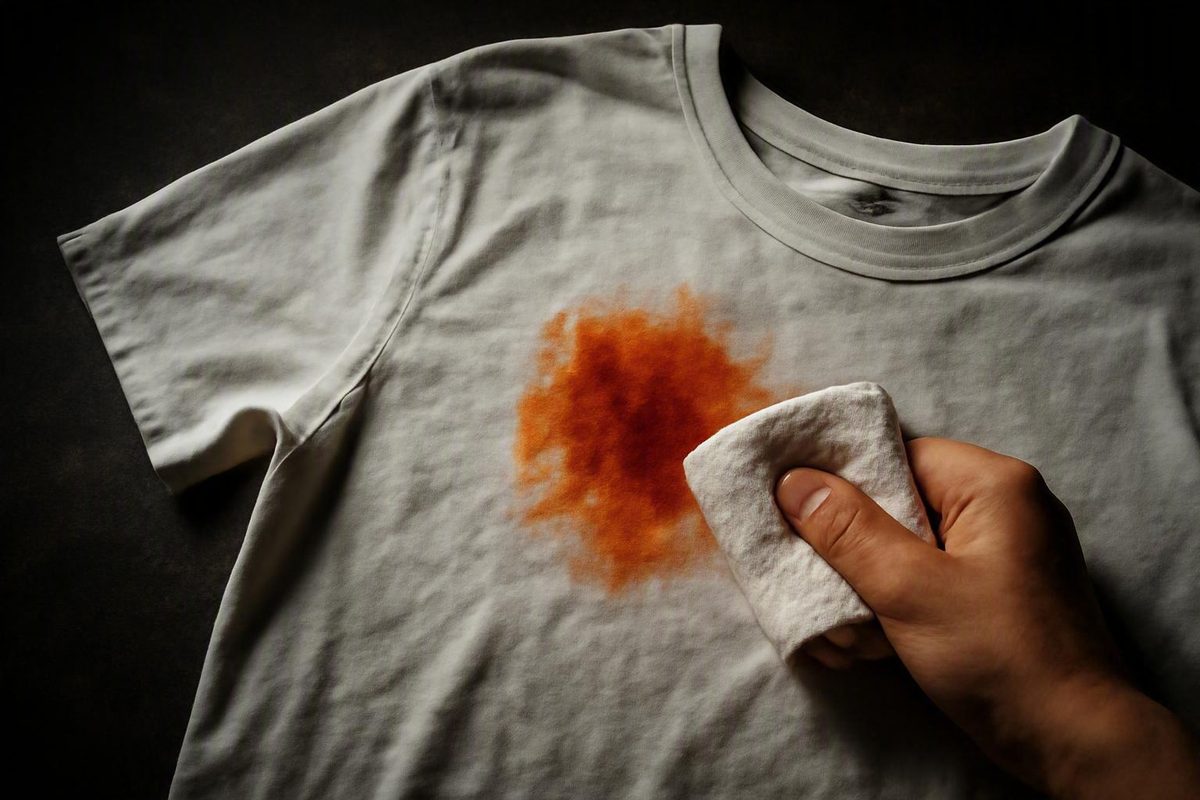
Old tomato sauce stains call for controlled treatment, not the harshest cleaner available. First confirm that the garment is washable. Then lift away dried residue, rehydrate and flush the mark with cool water, pretreat it with an enzyme-containing detergent or stain remover, and wash within the care label’s limits. Inspect and air-dry the garment instead of putting it in a machine dryer.
Dryer heat can make residual discoloration substantially harder to remove and may make it permanent. A heat-exposed stain is worth a cautious treatment attempt on a suitable washable garment, but the outcome is uncertain. No responsible method can guarantee complete removal from an old, washed, or machine-dried item.
Start Here: Is the Garment Safe to Treat at Home?
Before applying water, detergent, or bleach, make four decisions:
- Is the garment washable? Read the care label rather than assuming that a familiar-looking fabric can be soaked or machine-washed.
- What is the fiber? Identify cotton, polyester, wool, silk, or a blend if the label provides that information.
- What color and finish are involved? White, pale, dark, bright, and patterned garments carry different risks of visible color change.
- How did the stain dry? Determine whether it air-dried, survived an earlier wash, or went through a heated machine dryer.
The standard home procedure in this guide is intended for washable clothing, especially sturdy cotton, polyester, and compatible blends. It is not a universal method for every material carrying a tomato sauce mark.
If the label says dry clean only, spot clean only, or otherwise prohibits washing, do not apply the standard soak-and-launder procedure. For silk, leather, suede, and other delicate or non-washable materials, gently lift loose surface residue without rubbing and seek specialized care. Professional-cleaning guidance also identifies silk, wool, leather, and dry-clean-only garments as cases in which home treatment carries greater risk in this fabric-specific tomato-stain guide.
Treat wool and knitted garments as special cases even when the label permits washing. Avoid scrubbing or brushing them, and do not use hot water or a general-purpose bleaching treatment. Use only a fiber-appropriate product and the method specified on the care label. A cleaner is the conservative choice for valuable wool, cashmere, tailored clothing, unstable dye, or any garment whose construction or fiber content is uncertain.
Before using peroxide, oxygen bleach, vinegar, or another treatment that might affect color or finish, test a concealed area:
- Apply a small amount in accordance with the product directions.
- Blot with a white cloth.
- Rinse if the directions require it.
- Allow the test area to dry before comparing it with the surrounding fabric.
Stop if dye transfers, the test area becomes lighter, or the finish or texture changes.
Set realistic expectations before beginning. An old stain may require more than one careful treatment cycle, but full removal is not guaranteed. If the garment has already been machine-dried, approach treatment as an uncertain recovery attempt rather than a reliable fix. The goal is to reduce the mark without replacing it with fading, damaged fibers, or distortion.
The Core Method for an Old Stain on Washable Clothing
Use this sequence for a washable shirt, pair of trousers, or similarly constructed garment. Check both the garment care label and the treatment-product label before beginning.
1. Lift away dried sauce
Place the garment on a clean surface. Use the edge of a spoon, a dull table knife, or another blunt edge to lift away crusted sauce.
Work patiently and use little pressure. Do not grind the dry deposit into the fabric or scrape so hard that the surface becomes abraded. If the residue does not lift readily, proceed to dampening instead of applying more force.
2. Dampen and flush with cool water
Moisten the marked area with cool water. When you can reach the reverse side, position the visible stain face down and run cool water through the back of the fabric. Reverse-side flushing is intended to carry loosened residue back out rather than drive it farther through the garment.
For a lining, thick seam, padded area, or garment that cannot be positioned under running water, dampen and blot the affected area rather than immersing the whole item by default.
Removing excess sauce, flushing cold water through the back, gently applying liquid detergent, and checking the garment before drying form the central washable-fabric sequence in the American Cleaning Institute’s tomato-based stain guidance.
3. Apply enzyme-containing detergent or stain remover
Apply an enzyme-containing liquid laundry detergent or enzyme stain remover that is suitable for the garment. Cover the full stained area without unnecessarily treating unrelated sections.
Use the amount and dwell time printed on the product label. Published recommendations vary, so there is no single pretreatment time that applies to every formula, fabric, and old tomato stain.
If an enzyme formula is unavailable, ordinary liquid laundry detergent remains a supported first-line option. The available evidence does not establish that every ordinary detergent performs as well as a dedicated enzyme pretreatment on persistent food residue, but a particular branded pod, spray, or tomato-specific product is not required.
4. Work the treatment in gently
Use clean fingertips to distribute the product through the affected fibers. On sturdy woven cotton or polyester, you may lightly press the fabric against itself.
Do not scrub aggressively. Avoid brushes on wool, knits, lightweight fabrics, loose weaves, printed surfaces, or garments already showing wear. If the material cannot tolerate gentle manipulation, stop and use a more conservative care-label method.
5. Wash according to the care label
Wash with laundry detergent on a cycle and at a temperature permitted by the garment’s care label. “Warmest permitted” does not automatically mean hot: one garment may allow warm water while another permits only cold.
Check the pretreatment label as well. Choose a method compatible with both sets of directions, and never exceed the garment’s stated temperature limit in an attempt to accelerate stain removal.
6. Remove, inspect, and air-dry
Unload the garment promptly and inspect the marked area in good light. If any discoloration remains, keep the garment out of the machine dryer.
Air-dry it and inspect again once fully dry. If the mark remains, return to pretreatment rather than applying dryer heat. Laundry-product guidance likewise directs users to rewash a persistent tomato stain before drying rather than placing the marked garment in the dryer in this tomato sauce treatment sequence.
7. Repeat if the mark is improving
If the stain is visibly lighter and the garment shows no fading, surface change, or distortion, repeat the enzyme pretreatment and care-label-compatible wash. A second controlled detergent treatment is generally the appropriate step before considering bleach or an optional household remedy.
If a correctly performed cycle produces no visible improvement, reassess rather than repeating indefinitely. Confirm that the product covered the entire mark and remained in place for the label-directed time. Escalate only if the garment is compatible and the likely benefit justifies the additional risk.
Quick reference
- Lift dried sauce with a spoon or dull edge.
- Flush from the back with cool water when practical.
- Pretreat with enzyme detergent or stain remover as directed.
- Wash within the care label’s limits.
- Air-dry instead of machine-drying.
- Inspect in good light.
- Repeat only while the stain is improving and the fabric remains unchanged.
Why the Method Uses Cool Water First but May Wash Warmer Later
The initial rinse and the later wash are separate stages with different purposes.
The initial cool-water flush rehydrates dried residue and helps carry loosened material out of the fabric. Multiple tomato-stain guides recommend cool or cold water for this first dampening or reverse-side rinse.
The later wash follows pretreatment. It may use cold, cool, or warm water depending on the garment’s care label and the treatment product’s directions. If the label permits a warm wash, using it at this stage does not contradict the cool initial rinse. Conversely, an instruction to use the warmest permitted wash does not authorize hot water for every garment.
To flush from the reverse side:
- Turn the garment so you can reach the back of the marked area.
- Hold the visible side downward over a basin.
- Direct cool water onto the back of the cloth.
- Allow loosened residue to leave through the visible side.
- Keep the marked surface from resting against a clean part of the garment.
Published sources diverge once they move beyond the initial rinse. Some call for continued cold treatment, some suggest a later warm soak, and others describe prolonged soaking for particular washable fabrics. Because the recommendations differ—and because fabrics, dyes, finishes, and products vary—there is no sound universal prescription for a hot, warm, cold, or overnight soak.
Do not make overnight soaking the default response to every old stain. If you are considering a soak, first confirm that:
- The garment is washable and safe to immerse.
- The product provides instructions for soaking.
- The garment’s color is stable.
- The specified water temperature complies with the care label.
- The lining, trims, prints, and embellishments are compatible.
The practical rule is simple: begin with a cool local flush, then select the wash or optional soak conditions from the garment and product labels rather than from a universal tomato-stain recipe.
Choose the Treatment by Fabric, Color, and Washability
Fabric category, color stability, construction, and washability determine how far treatment should go. A procedure tolerated by plain white cotton may be inappropriate for dark wool or a printed silk blouse.
| Garment category | First treatment | Possible escalation | Avoid |
|---|---|---|---|
| Sturdy washable cotton | Cool reverse-side flush, enzyme detergent or stain remover, then a care-label-compatible wash | Label-directed oxygen bleach after testing if both labels permit it | Aggressive scraping, excessive heat, machine-drying before inspection |
| Washable polyester or blend | Core cool-flush and enzyme-detergent method | Oxygen bleach only after compatibility and colorfastness are established | Assuming synthetic dyes, trims, or finishes are bleach-safe |
| White or light, colorfast washable | Core detergent method first | Label-compatible oxygen bleach after testing | Treating whiteness as proof that any bleach is safe |
| Dark, bright, or patterned washable | Prioritize detergent treatment and repetition while improving | Oxygen bleach only if both labels permit it and testing shows no immediate change | Unverified peroxide or bleaching treatments |
| Wool or knit | Fiber-appropriate, care-label-compatible gentle treatment | Professional cleaner for old, valuable, tailored, or uncertain items | Scrubbing, brushing, hot water, general-purpose bleach, twisting |
| Silk, leather, or suede | Lift loose residue gently | Specialized professional care | Standard soaking or laundering |
| Spot-clean-only or dry-clean-only garment | Remove loose surface residue without rubbing | Professional cleaning | Applying the washable-fabric procedure |
Sturdy washable cotton
Cotton often accommodates the core procedure, but the word “cotton” does not answer every compatibility question. The garment may also contain unstable dye, elastic, interfacing, embroidery, printed finishes, or a non-cotton lining.
Begin with enzyme detergent. If repeated detergent treatment reduces but does not remove the mark, oxygen bleach may be considered only when the garment and product labels permit it and a hidden-area test remains unchanged.
Washable polyester and blends
Use the same core method: cool reverse-side flushing, gentle enzyme pretreatment, a compatible wash, and air-dry inspection. Test any bleaching treatment because dyes and finishes can react even when the base synthetic fiber is washable.
A cotton-polyester garment with wool trim, for example, should not be handled as if it were a plain cotton-polyester T-shirt.
White and light-colored washables
White or pale, colorfast washables may offer more escalation options, but color alone does not establish bleach compatibility. Prints, contrasting thread, finishes, elastic, and nonwhite trims can respond differently.
After detergent treatment, label-directed oxygen bleach may be a reasonable next step. It is an escalation, not the mandatory opening treatment and not a guaranteed solution.
Dark, bright, and patterned clothing
Prioritize detergent treatment and patience. A remaining faint mark may be less conspicuous than permanent color loss.
Do not use hydrogen peroxide or oxygen bleach merely because a product is described as suitable for colors. Confirm compatibility from the garment and product labels, then perform a hidden-area test. On a multicolored fabric, an unchanged test on one color does not establish that every color in the pattern is stable.
Wool and knits
Avoid scrubbing, brushing, twisting, hot water, and general-purpose bleaching treatments. If the care label permits washing, use a wool-appropriate product and the specified washing and drying method. Guidance for wool and knits specifically favors gentle handling and cautions against adapting ordinary sturdy-fabric treatment to these materials.
Seek professional care for tailored wool, cashmere, valuable knitwear, unstable dye, or construction that makes wet handling uncertain. The remaining tomato mark may be less damaging than shrinkage, felting, color loss, or distortion.
Silk, leather, suede, and non-washable garments
Remove only loose material with a spoon or dull edge. Do not improvise the washable-clothing process with a small amount of water or detergent. Instead, use the specialized method permitted by the care label or take the item to an appropriate cleaner.
Tell the cleaner that the stain is tomato sauce, approximately how old it is, whether the garment was washed or machine-dried, and which products have already been applied.
What to Do When the First Wash Leaves a Red or Orange Shadow
Tomato sauce can leave a mixed food stain involving red pigment, oily ingredients, spices, sugar, and other residues. Sauces containing meat, cheese, cream, or substantial cooking oil may be more complex than plain tomato juice, so one treatment cycle may not address every component as described in this overview of dried tomato sauce stains.
An orange-red, translucent, or slick-looking shadow may involve pigment, oil, other residue, or a combination; appearance is not an objective chemical test.
First, repeat the enzyme-detergent treatment
If the first cycle produced visible improvement and the fabric remained unchanged, pretreat and wash again. Confirm that the product covered the complete mark and remained in place for the time stated on its label.
One incomplete cycle does not automatically justify bleach. An old stain may respond gradually, so repeating the lower-risk treatment is the appropriate first escalation when progress is visible.
Next, consider oxygen bleach for compatible washables
Oxygen bleach may be considered for a compatible, washable, colorfast garment, especially a white or light-colored item. Before using it:
- Read the garment care tag.
- Read the oxygen-bleach label.
- Confirm that the product permits use on the fiber and color.
- Test a concealed area.
- Stop if dye transfers, the test area lightens, or the finish changes.
- Follow the manufacturer’s concentration, water-temperature, and treatment-time instructions.
There is no universal oxygen-bleach concentration, temperature, or soak time for every garment. Use only the directions supplied for the particular product and ensure that they remain within the garment’s care limits. Professional garment-care guidance makes oxygen bleach conditional on fabric suitability, dye stability, label directions, and prior testing.
After treatment, rinse or wash as directed and air-dry for inspection. Keep the garment out of the machine dryer while discoloration remains.
Know when to stop
Stop home treatment if:
- Dye transfers or the garment color changes.
- The treated surface becomes fuzzy, rough, thin, or otherwise altered.
- Seams, knits, or panels begin to distort.
- A print or finish changes.
- Additional correctly performed cycles produce no visible improvement.
- The remaining mark is less objectionable than the risk of further escalation.
There is no fixed number of cycles appropriate for every garment. Visible progress and the condition of the fabric are better stopping criteria than an arbitrary count.
Stop earlier with a valuable or irreplaceable garment. Professional care cannot guarantee removal, but it may offer a more controlled assessment than continued home experimentation. Bring the product names or labels for anything already used.
If the Garment Has Already Been Through the Dryer
A naturally air-dried stain and a machine-dried stain do not have the same prognosis. Machine-dryer heat can make remaining tomato discoloration harder to remove, and stain-care guidance warns that a stain dried before full removal may become permanent in the American Cleaning Institute’s instructions.
That does not establish that a dryer-exposed stain can be recovered. It means a suitable washable garment may be treated cautiously, with no promised outcome.
Use the core method:
- Lift remaining dry surface residue.
- Rehydrate and reverse-flush the mark with cool water when practical.
- Apply enzyme detergent or stain remover for the label-directed time.
- Wash within the garment’s care limits.
- Air-dry and inspect.
- Repeat only if the mark becomes visibly lighter and the fabric remains unchanged.
- Consider oxygen bleach only if the garment is washable, colorfast, tested, and compatible with the product.
Do not rely on repeated washing alone when a persistent stain has not been directly pretreated. The supplied guidance for old stains supports applying liquid detergent or an enzyme pretreatment before laundering again.
Keep the garment out of the dryer while the mark remains visible. This is especially important after an incomplete result: a lighter stain is still present.
Move to professional care sooner when the garment is:
- Valuable or irreplaceable.
- Delicate, tailored, or embellished.
- Made from wool, silk, leather, or suede.
- Labeled dry clean only or spot clean only.
- Showing dye movement, finish changes, or distortion.
- Not changing after a properly performed treatment.
A cleaner may also be unable to remove a heat-exposed stain completely.
Household Remedies: What the Evidence Does and Does Not Establish
Advice for old tomato sauce stains often expands into recipes involving vinegar, peroxide, dish soap, lemon juice, baking soda, or several ingredients at once. The presence of those recipes in stain guides does not establish which one is superior or compatible with a particular garment.
Across the supplied guidance, liquid laundry detergent is the most consistent first-line treatment. Enzyme-containing detergent or stain remover is repeatedly suggested for old or persistent food residue. That supports a simple treatment hierarchy rather than a series of competing household recipes.
Liquid laundry detergent
An enzyme-containing liquid formula is preferred for the core method because multiple old-stain guides specifically recommend enzyme treatment for persistent sauce residue. Apply it according to its label.
If an enzyme product is unavailable, ordinary liquid laundry detergent is a reasonable first treatment. The evidence does not show that a branded pod, spray, or tomato-specific remover is necessary or superior.
Dish soap
Some sources suggest dishwashing liquid, alone or in a household recipe. It may be considered as an optional local treatment for oily food residue, but the supplied evidence does not establish that it outperforms laundry detergent on an old tomato sauce stain.
If the remaining problem appears to be a separate oil mark after the tomato treatment is complete, consult guidance specifically devoted to treating a persistent grease or oil stain rather than assuming every grease procedure is automatically suitable for tomato sauce.
White vinegar and lemon juice
White vinegar and lemon juice appear in some tomato-stain instructions, generally for white or tested colorfast fabrics. Neither is a required step, and the available evidence does not establish that either is better than repeated detergent treatment.
If you choose an optional treatment mentioned by a garment-care source, first verify that it is permitted for the fabric, test a concealed area, and follow the stated directions. Do not assume that a familiar household product is universally fabric-safe.
Hydrogen peroxide
Hydrogen peroxide is a bleaching treatment rather than a neutral all-purpose cleaner. It may affect colored fabric. Fabric-specific tomato-stain guidance advises checking the care label and patch-testing because peroxide can alter colors before using it on a garment.
Do not make peroxide the default treatment for dark, bright, patterned, delicate, or uncertain clothing. Even on white fabric, check the fiber, construction, trims, finishes, and care-label restrictions. Whiteness alone does not establish chemical compatibility.
Baking soda
Baking soda appears in some household stain advice, but the supplied evidence does not establish it as necessary or superior for old tomato sauce stains. There is little reason to make it the opening treatment when a label-compatible liquid detergent provides a simpler and more consistently supported route.
Oxygen bleach and chlorine bleach are not interchangeable
Oxygen bleach may be considered after detergent treatment for compatible, washable, colorfast clothing. Use the product label’s method rather than borrowing a concentration or soak duration from an unrelated recipe.
Do not substitute chlorine bleach automatically. The supplied tomato-stain evidence does not support chlorine bleach as a default treatment, including for every white garment. Fiber content, trims, finishes, garment construction, and care-label restrictions still govern whether any bleaching treatment is appropriate.
Keep the process controlled
This guide does not recommend improvised cleaner combinations because the supplied evidence does not establish their superior performance or compatibility across fabrics, dyes, and finishes. Complete one care-label-compatible treatment, reassess the garment, and choose the next step based on documented product directions.
A controlled sequence is easier to evaluate:
- Use enzyme-containing detergent or stain remover first.
- Use label-compatible oxygen bleach second only for suitable, washable, colorfast garments.
- Choose professional cleaning for delicate, valuable, non-washable, damaged, or resistant items.
The practical answer to how to remove old tomato sauce stains from clothing safely is therefore straightforward: check the care label, treat only appropriate washables at home, lift residue gently, begin with a cool reverse-side flush, pretreat with enzyme detergent, wash within the garment’s limits, and air-dry before judging the result.
Repeat only while the stain continues to improve and the fabric remains sound. Patience may reduce an old mark, but no household remedy or branded product can promise complete removal after time or dryer heat.
Frequently Asked Questions
Can an old tomato sauce stain come out after it has been through the dryer?
The outcome is uncertain. Dryer heat makes remaining discoloration more difficult to remove and may make the stain permanent, so treatment should be framed as a cautious attempt rather than an expected recovery.
For a suitable washable garment, follow the core method: cool-water rehydration, reverse-side flushing when practical, enzyme pretreatment for the product’s stated time, a care-label-compatible wash, and air-dry inspection. Repeat only if the mark becomes visibly lighter and the fabric remains unchanged.
Keep the garment out of the dryer throughout further treatment. Seek professional care sooner if it is valuable, delicate, non-washable, or not responding.
How long should enzyme detergent stay on an old tomato sauce stain?
Use the dwell time printed on the detergent or stain-remover label. Recommendations vary by formula, so there is no universal treatment time suitable for every product and garment.
Apply enough product to cover the affected fibers and follow all label instructions. If the product provides no appropriate pretreatment directions, choose one that does rather than assuming that a longer or overnight application will be more effective.
Can I use oxygen bleach on a colored garment?
Only if all of the following conditions are met:
- The garment is washable.
- Its care label permits the treatment.
- The oxygen-bleach label identifies the fabric and color as compatible.
- A concealed-area test shows no immediate dye, texture, or finish change.
A “color-safe” description is not a guarantee for every dye, print, trim, or finish. Be particularly cautious with dark, saturated, bright, and patterned garments. Stop if dye transfers or the test area lightens.
Should I soak the entire garment or only dampen the stained area?
Start with local dampening and treatment.
Consider whole-garment soaking only when:
- The garment is washable and safe to immerse.
- The product explicitly provides soaking instructions.
- The care label permits the specified temperature.
- The dyes, trims, lining, prints, and embellishments are compatible.
- The size or distribution of the stain makes local treatment impractical.
Because published guidance differs on soak temperature and duration, do not rely on a universal overnight-soak recipe. Follow the specific garment and product labels.
When should I stop treating the stain and take the garment to a cleaner?
Stop if dye transfers, the treated area lightens, the texture or finish changes, the material appears weakened, or the garment begins to distort. Also stop when correctly performed treatment cycles no longer produce visible improvement.
Choose professional care from the outset for dry-clean-only or spot-clean-only garments and for silk, leather, suede, valuable items, or structurally complex clothing. Wool and knits may also warrant professional care when the item is valuable or its requirements are uncertain.
Tell the cleaner that the stain is tomato sauce, how old it is, whether it went through a dryer, and which products were applied. Professional treatment cannot guarantee complete removal, but it can avoid exposing a vulnerable garment to increasingly aggressive home treatment.