 StainList
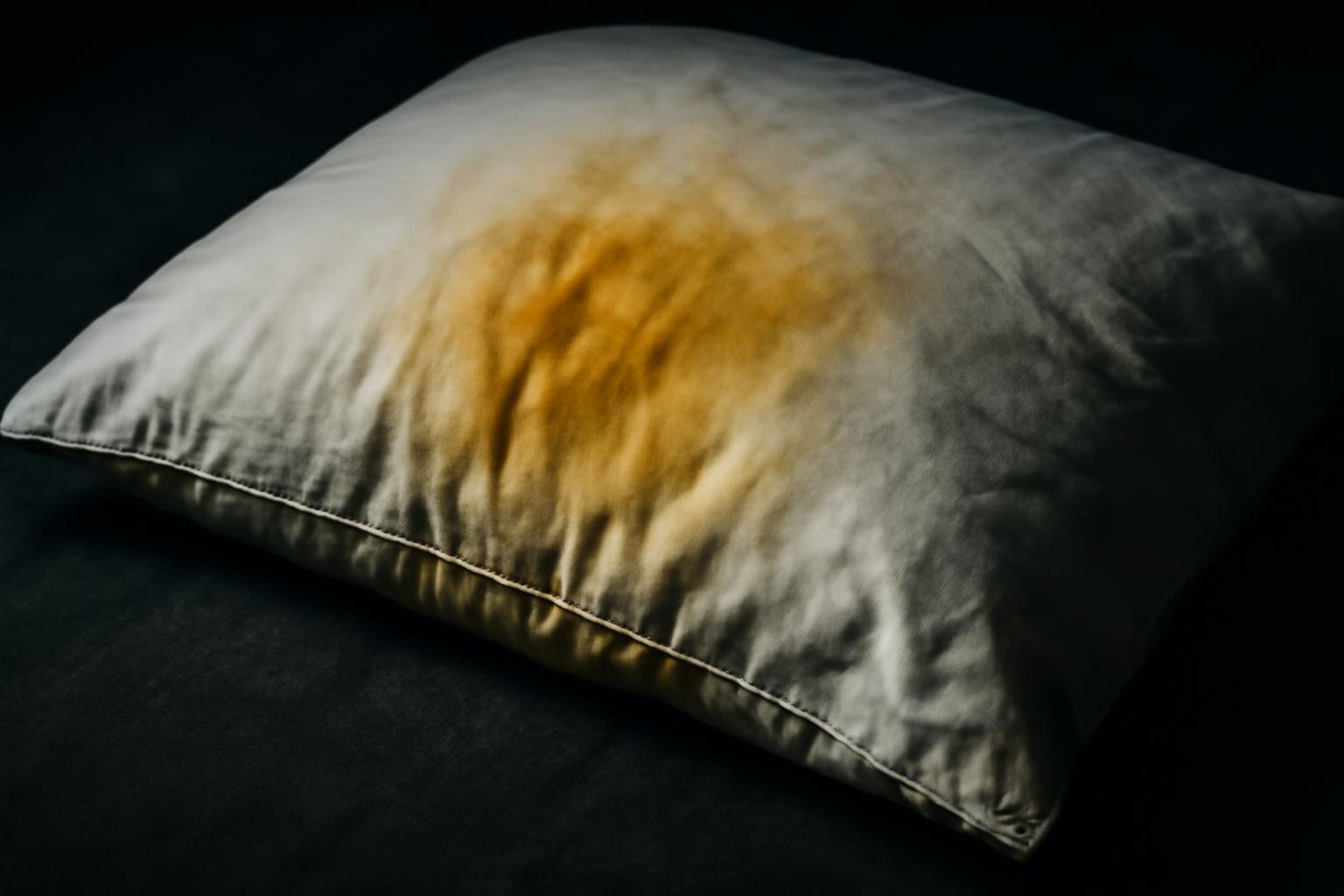
The short answer: moisture carries residues into the pillow
Pillows usually turn yellow because repeated contact with sweat, skin and hair oils, saliva, damp hair, and personal-care products leaves residue behind. A pillowcase reduces that transfer, but ordinary woven fabric does not necessarily stop moisture and oil from reaching the pillow beneath it.
The change is generally cumulative. One warm night or isolated drooling episode may leave temporary dampness without producing an obvious stain. Over many nights, however, small amounts of moisture and residue can enter the pillow shell—and, depending on its construction, the fill—before drying there.
Moisture acts as a transport mechanism. Perspiration and other fluids can carry salts, proteins, fats, oils, and product residues into the fabric. As those materials dry and age, they may become more visible. Exposure to air and oxidation may also contribute to yellow, gold, or light-brown discoloration, although the precise process will vary with the substance and pillow material. Commercial bedding guidance from Casper describes yellowing as a gradual moisture-and-residue process that may involve oxidation.
That is why a clean pillowcase can conceal a pillow that is slowly changing color underneath. The case is washed repeatedly, while the pillow shell may retain whatever passed through it between washes.
The practical takeaway is straightforward: ordinary yellowing is usually accumulated residue rather than evidence that something dramatic happened overnight. Before trying to remove it, determine which layer is stained and what that layer is made from.
The most likely sources of yellow stains
Several sources can contribute at the same time.
Sweat is a common contributor. Perspiration does not need to look yellow when it leaves the body. Clear moisture can carry salts, proteins, oils, and other materials into the pillow, and the deposited residue can become visible after repeated drying and aging. Someone who sleeps hot may notice broader staining where the head and neck rest, but that pattern is only suggestive.
Skin and hair oils transfer through repeated contact. The face, scalp, hairline, and neck rest against a relatively small area for hours at a time. Even modest nightly transfer can gradually produce a yellow or brownish patch. Good Housekeeping attributes pillow discoloration to mixed body soils—including water, fats, proteins, and salts—rather than to one substance alone. Its consumer cleaning overview explains how these residues discolor as they age.
Oily residue may also require a different cleaning approach from a simple water mark, although the pillow’s label and construction must still control the treatment. The same distinction applies more broadly when dealing with grease and oil stains on washable materials.
Saliva may be involved when staining is concentrated near the mouth-facing area or along an edge where a sleeper commonly turns their face. Repeated wetting can leave residue. Still, location is not proof: that area may also receive facial oil, moisturizer, sweat, or hair product.
Damp hair provides another route for moisture. After a shower, water can move from the hair through the pillowcase and into the pillow shell. Leave-in conditioner, styling cream, hair oil, or other products may travel with it. This can create a localized patch beneath the scalp, although movement during sleep may produce broader discoloration.
Skincare and personal-care products can transfer before they have absorbed or dried. Possible contributors include:
- Face and body lotions
- Moisturizers and overnight creams
- Hair conditioners and leave-in treatments
- Hair oils, styling products, and serums
- Perfume or fragranced body products
- Makeup or tinted skincare left on overnight
These products vary widely in composition. Some contain oil or pigment, so a face-side stain may be a blend of perspiration, skin oil, makeup, and skincare rather than one identifiable substance.
Humidity and spills are additional moisture sources. A humid bedroom may slow evaporation, while a drink spill can wet the pillow directly. Neither should be assumed to be the cause of every yellow stain, but both can add to routine moisture exposure. Sleep Foundation lists sweat, drool, wet hair, and skincare products among the common contributors to gradual yellowing.
Use the stain pattern only as a starting point:
- A face-side patch may reflect facial oil, sweat, makeup, or skincare.
- A scalp-shaped area may reflect hair oil, sweat, damp hair, or hair products.
- An edge patch may be consistent with repeated drooling.
- Broad yellowing may involve perspiration, humidity, general fabric aging, or several contributors.
- A sharply defined mark may reflect a spill or repeated contact in one position.
The cleaning decision should not depend on identifying the exact source. It should depend on the stained layer, the pillow’s construction, its care label, and whether there are concerns beyond color.
Why a pillowcase does not stop the yellowing
An ordinary pillowcase is a removable fabric cover, not necessarily an impermeable moisture or oil barrier. It catches direct soil and absorbs some moisture, which is why washing it regularly is useful. But small amounts of liquid and oil can still pass through woven fabric.
Each transfer may be minor. Over time, however, residue can reach the pillow’s outer shell. Depending on the construction, moisture may also move farther into the fill. Because the pillowcase is usually washed much more often than the pillow, the case may look clean while older residue remains underneath.
It helps to separate the bedding into distinct layers:
- Pillowcase: The sleeping surface removed with the sheets.
- Pillow protector: An optional washable barrier fitted beneath the pillowcase.
- Removable outer cover: A zippered cover supplied with some foam or specialty pillows.
- Pillow core: The internal fill, solid foam block, or other support structure.
These layers should not automatically receive the same treatment. A removable cover may be machine washable even when the core is not. A protector may tolerate laundering that would damage a foam core, while a delicate pillowcase may have gentler requirements than a washable synthetic-filled pillow.
A washable protector provides a second barrier and may slow the movement of moisture and oil. It is also easier to launder than many pillows. Good Housekeeping’s material-specific guidance distinguishes washable filled pillows from solid foam cores and recommends checking the care label before cleaning.
When you discover yellowing, strip the bed one layer at a time. Inspect both sides of the pillowcase, followed by the protector, removable cover, pillow shell, and any visible core. This shows what actually needs attention and may prevent an unnecessary—and potentially damaging—wash of the entire pillow.
Is a yellow pillow unsafe—or simply stained?
Yellow discoloration alone does not prove that a pillow is dangerous, moldy, or connected to a medical condition. In many cases, it is a cosmetic sign of accumulated body and product residue.
That residue can contribute to a stale or oily odor, particularly when the pillow has been repeatedly dampened or incompletely dried. Color alone, however, cannot establish what microorganisms or allergens are present. It should not be treated as a diagnosis of the pillow’s condition.
Pay attention to more than color:
- Does the pillow remain damp instead of drying normally?
- Does a musty odor persist after permitted cleaning and complete drying?
- Is there clearly visible growth rather than flat discoloration?
- Has the fill clumped, degraded, or become permanently compressed?
- Are the shell or seams damaged?
- Has the pillow lost its shape or support?
This article cannot provide a visual test for distinguishing every stain from mold or mildew. A dry, odor-free yellow mark is different from a pillow with persistent dampness, mustiness, or visible growth, but uncertain cases may require advice from the manufacturer or an appropriate professional rather than further home treatment. Commercial retailer guidance likewise says that discoloration alone is not automatically dangerous and recommends assessing more than color.
A pillow stain also cannot diagnose a sweat disorder. If perspiration itself appears unusually colored on the skin or clothing, the pillow is not a reliable basis for determining why. That question falls outside stain identification and is better raised with a healthcare professional.
For an ordinary dry yellow stain, the proportionate response is inspection, label-compatible cleaning, thorough drying, and prevention—not alarm.
How to clean a yellow pillow without damaging it
The safest approach is conservative:
- Identify which layer is stained.
- Determine the pillow’s fill and construction.
- Read the care label for that specific layer.
- Check the manufacturer’s current instructions if the label is unclear.
- Use the least aggressive treatment permitted.
- Test any compatible spot treatment in an inconspicuous area.
- Dry the cleaned item completely before reassembling the pillow.
Do not assume that a method described as suitable for “pillows” applies to yours. Solid memory foam, shredded foam, latex, down, feather, polyester fiberfill, and mixed constructions can respond differently to water, agitation, detergent, stain removers, and heat.
| Stained item | Conservative cleaning route | What to avoid |
|---|---|---|
| Pillowcase, protector, or removable cover | Remove it and launder it only as its own label permits. Treat the pillow core as a separate item with separate instructions. | Do not assume a washable cover means the core can be washed or soaked. |
| Pillow explicitly labeled machine washable | Follow the label’s directions for detergent, stain treatment, cycle, load arrangement, and drying. Make sure the pillow dries completely. | Do not invent a hotter wash, longer soak, stronger concentration, or higher dryer setting to force out the stain. |
| Solid memory-foam core | Wash the removable cover separately if permitted. If the manufacturer allows cleaning of the core, limited spot cleaning with minimal moisture may be appropriate. | Do not machine-wash, soak, wring, or submerge the core unless the manufacturer explicitly permits it. |
Solid memory foam is an important exception to generic pillow-washing advice. Saturation and agitation may damage its structure, and a soaked core may be difficult to dry completely. The English Home’s consumer cleaning guidance warns that memory foam is generally unsuitable for machine washing.
Other fills still require their own instructions. A washable down pillow does not necessarily use the same process as polyester fiberfill. Shredded foam should not be treated automatically as either a solid foam block or a conventional fiber-filled pillow. Feather, latex, and mixed-material constructions may have additional restrictions. If the label is missing and the construction cannot be identified, avoid full immersion until the manufacturer confirms that it is appropriate.
Consumer guides mention treatments such as enzyme detergents, oxygen-based bleach, diluted hydrogen peroxide, vinegar, baking soda, and lemon-based solutions. Their appearance in cleaning articles does not make them universally safe, equally effective, or interchangeable.
If the care instructions permit spot treatment:
- Follow both the pillow manufacturer’s directions and the cleaning product label.
- Test the treatment on a hidden seam or inconspicuous area first.
- Use one compatible treatment rather than improvising a mixture.
- Do not combine cleaning agents unless their labels explicitly instruct you to do so.
- Watch for color loss, rings, texture changes, or distortion.
- Keep moisture away from a non-washable core.
- Remove or rinse treatment residue only as directed.
- Stop if the material changes appearance or texture.
Never let the desire for a whiter pillow overrule the care label. A faint remaining stain is usually preferable to weakened fabric, damaged foam, clumped fill, or an interior that cannot be dried properly.
Set realistic expectations. Fresh surface residue on a washable cover may respond well, while an old stain that has repeatedly dried can be stubborn. Commercial bedding guidance acknowledges that results vary with the stain’s age and the pillow material, and that deeply set yellowing may lighten without disappearing completely.
If the pillow is valuable, unusually constructed, or filled with a material you cannot identify, contact the manufacturer or an appropriate professional cleaner.
Drying is part of the cleaning process
Cleaning is not finished when the wash cycle ends or the visible spot has been wiped. Any washed or spot-cleaned layer must dry completely before it returns to the bed.
Retained moisture can contribute to odor, fill clumping, or mildew. A cleaning-products manufacturer’s guidance advises checking the care label and drying washable pillows completely to reduce retained-moisture problems.
Use only the drying method and temperature permitted by the label. Do not default to high heat. A temperature suitable for one synthetic cover may be inappropriate for foam, a coated fabric, a delicate shell, or another fill.
For an approved machine-washable pillow:
- Follow the label’s dryer or air-drying directions.
- Check more than the outside surface.
- Feel for cool, dense, or clumped internal areas that may indicate retained moisture.
- Continue drying only by a permitted method.
- Keep the pillow off the bed until it is dry throughout.
For a spot-cleaned foam core, add as little moisture as practical and follow the manufacturer’s drying instructions. Leave the cover off until the treated area is fully dry. Replacing it too early can trap moisture and slow evaporation.
There is no reliable universal drying time. Judge dryness by the manufacturer’s instructions and the pillow’s actual condition rather than by a fixed number of hours.
If the pillow remains damp, becomes musty, or changes shape despite label-compatible cleaning and drying, discontinue the cleaning attempt and seek manufacturer guidance. Repeatedly adding more water is unlikely to resolve an internal moisture problem.
How to prevent yellow stains from returning
Prevention works best when it addresses both residue transfer and moisture retention. The aim is not to keep a pillow permanently pristine; it is to slow buildup and make the layers that receive it easier to clean.
Wash pillowcases regularly. They are the first contact layer and usually the easiest part of the bedding to launder. Published schedules vary, so adjust the routine for sweating, drooling, personal-care products, illness, spills, fabric type, and the care label rather than treating one interval as universal.
Use a washable pillow protector. Place it between the pillow and pillowcase. It can collect moisture and oils that might otherwise reach the shell. Wash it according to its own label, and do not assume the pillow beneath it shares those instructions.
Go to bed with dry hair. If you shower at night, allow the scalp and hair to dry instead of relying on the pillow to absorb the remaining water.
Let personal-care products settle. Apply moisturizers, lotions, hair treatments, and leave-on products early enough to absorb or dry before your face and hair contact the pillow.
Respond to spills promptly. Remove the affected case and protector, inspect the pillow, and follow the relevant care labels. Do not return any wet layer to the bed.
Manage excess bedroom moisture. If the bedding routinely feels damp or the room has a persistent humidity problem, address airflow or moisture conditions rather than repeatedly treating the resulting discoloration.
Clean the pillow only when permitted. Published washing schedules are general consumer recommendations, not universal requirements. Construction, manufacturer instructions, and actual condition are more useful than a generic calendar.
Dry every cleaned layer completely. Do not reassemble the pillow while the protector, removable cover, shell, or core is still damp.
Replacement should be based primarily on condition rather than yellow color alone. A cosmetically discolored pillow may still be usable when it is dry, odor-free, structurally intact, supportive, and maintainable according to its care instructions.
Replacement may be more practical when:
- Odor persists after permitted cleaning and complete drying.
- The pillow repeatedly retains internal moisture.
- Clearly visible growth is present.
- The shell, seams, or fill are damaged.
- The fill has permanently clumped or degraded.
- The pillow has lost its shape or support.
- Safe cleaning has not produced an acceptable result.
- The manufacturer identifies a material or structural reason to replace it.
Some consumer publications recommend replacing pillows every one to two years, but this is general guidance rather than a mandatory deadline. Good Housekeeping reports that experts have suggested a one-to-two-year interval, while actual condition, support, care history, and manufacturer instructions remain more useful decision points.
A quick prevention checklist
- If you sleep hot: Use a washable protector, change the pillowcase as needed, and never return a damp pillow to the bed.
- If you drool: Pay attention to the mouth-facing edge and wash the removable layers before residue builds up.
- If you shower before bed: Dry your hair and scalp fully.
- If you use leave-on skincare: Apply it earlier and allow it to absorb before lying down.
- If you use hair oil or conditioner: Let the product settle or dry, and clean the removable layers regularly.
- If the room feels humid: Improve airflow or address excess moisture.
- After a spill or cleaning: Inspect every affected layer and dry it completely.
Frequently asked questions
Can clear sweat really turn a pillow yellow?
Yes. Sweat does not have to be visibly yellow when it reaches the pillow. Clear perspiration can carry salts, proteins, oils, and other residue through the pillowcase. Repeated deposits may become yellow or brownish as they dry and age.
The process is usually gradual. A yellow pillow does not necessarily mean that one night involved an unusual amount of sweating.
Can I machine-wash a yellow memory-foam pillow?
Generally, do not machine-wash a solid memory-foam core unless its manufacturer explicitly permits it. Agitation and saturation may damage the foam, and a soaked core can be difficult to dry completely.
Check for a removable washable cover and clean it according to its own label. If the manufacturer permits spot cleaning of the core, use minimal moisture and allow it to dry fully before replacing the cover.
Shredded-foam pillows may have different instructions, so do not apply solid-foam guidance automatically.
Will yellow pillow stains come out completely?
Not always. A fresh surface stain on a washable cover may respond better than discoloration that has accumulated and dried repeatedly. Results also depend on the residue, fabric, fill, previous treatment, and methods allowed by the care label.
An old stain may lighten without disappearing. Do not automatically escalate to stronger chemicals, hotter water, soaking, or high heat.
Does a yellow pillow need to be replaced?
Not because of color alone. A dry, odor-free, supportive pillow with cosmetic discoloration may remain usable if it can be maintained according to its care instructions.
Consider the pillow’s actual condition: retained dampness, persistent odor, visible growth, damaged or clumped fill, a compromised shell, lost support, failed cleaning, and manufacturer guidance are more meaningful than color by itself.
How can I keep my pillow from turning yellow again?
Wash the pillowcase regularly, add a washable protector, go to bed with dry hair, and allow lotions, moisturizers, and hair products to absorb or dry before lying down. Treat spills promptly and address persistent bedroom moisture.
Clean the pillow itself only when its label permits it, and dry every layer completely afterward. These measures can slow residue buildup, although no ordinary pillowcase or protector can guarantee that yellowing will never return.
Yellowing is usually a record of accumulated moisture and residue, not an automatic sign of danger. Inspect the affected layer, identify the construction, follow the care label, use the least aggressive permitted treatment, and dry everything completely. A washable protector and lower-moisture bedtime habits can slow future staining.
If persistent odor or dampness, visible growth, damaged fill, or poor support remains, seek manufacturer advice or replace the pillow rather than repeating increasingly aggressive stain treatments.