 StainList
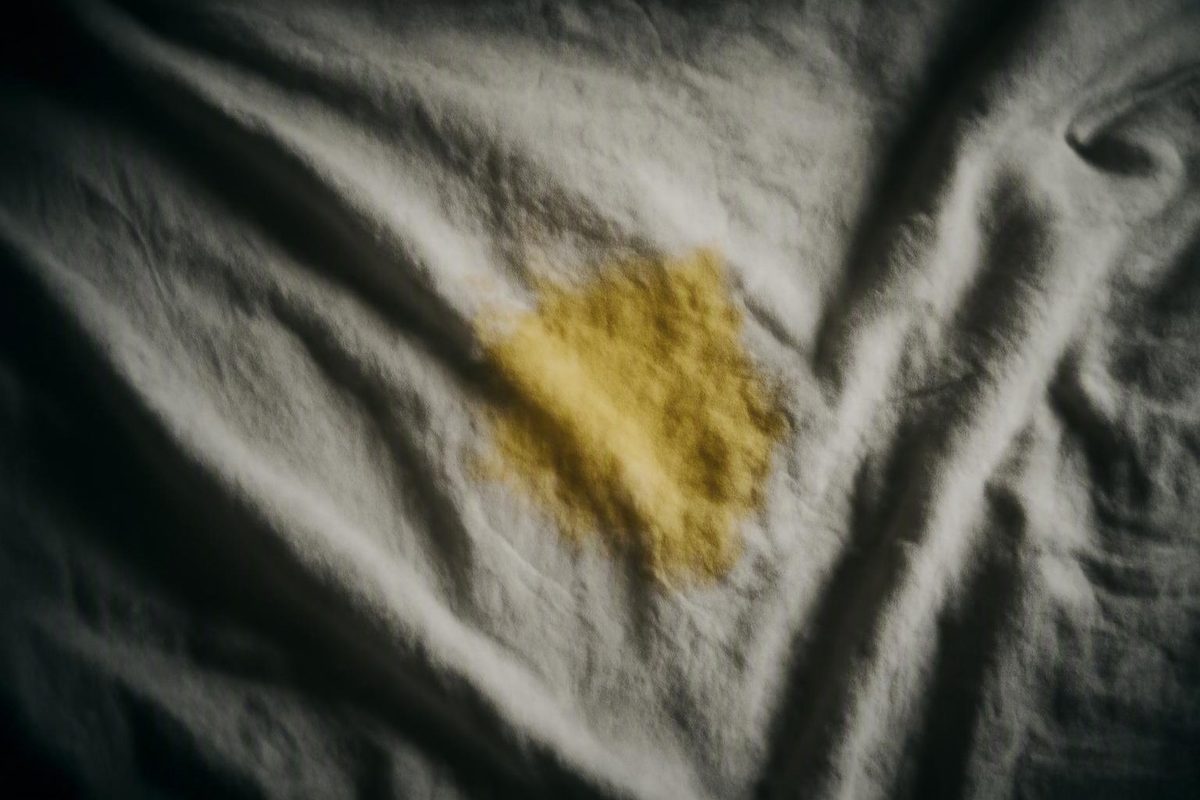
Yellow stains on bed sheets commonly involve accumulated perspiration and body oils, but “sweat stain” is not a reliable diagnosis. Saliva, urine, skincare, hair products, laundry residue, water minerals, oxidation, and previous dryer heat can produce or intensify similar discoloration.
The safest approach is to identify the most plausible residue, check the sheet’s fiber and care label, and begin with the least aggressive compatible treatment. Pretreat the affected area, wash at a temperature appropriate for both the residue and fabric, and inspect the sheet before machine drying. Old or heat-exposed yellowing may improve without disappearing completely.
Why bed sheets develop yellow stains
Sheets collect small amounts of material whenever they contact skin and hair. Perspiration, skin oil, saliva, shed skin, and transferred personal-care products can accumulate gradually, especially where the head, shoulders, and torso rest. Several residues may occupy the same patch: a mark might contain perspiration, oil, face cream, and hair product rather than one easily isolated substance.
Possible contributors include:
- Perspiration and body oils
- Saliva and other bodily residues
- Lotions, night creams, ointments, and hair products
- Sunscreen and self-tanner
- Urine or other localized fluid contamination
- Excess detergent or fabric-softener residue
- Minerals associated with the wash water
- Older residue becoming more visible over time
- Previous exposure to washer or dryer heat
These are possibilities, not diagnoses. Yellowing caused mainly by oily lotion transfer may require a different pretreatment from a fresh bodily-fluid mark. Broad dinginess caused by accumulated residue may call for a different approach again.
Oxidation is often used to describe gradual changes that make older residue more visible and resistant. It may help explain why a sheet looks increasingly yellow even when no dramatic spill occurred. It does not mean every yellow mark is oxidized, and oxidation cannot be confirmed from color alone.
Yellowing can also become more noticeable after laundering. Ordinary washing may remove some material while leaving older residue behind. Too much laundry product, fabric softener, inadequate rinsing, or minerals in the water may contribute to a dull appearance. Dryer heat can make remaining discoloration harder to lift. Miracle Made’s commercial overview lists bodily residue, personal-care products, laundry buildup, water conditions, and high dryer heat as overlapping troubleshooting possibilities rather than one universal cause (possible causes of yellow sheets).
Do not assume that a yellow-orange mark proves sunscreen reacted with water minerals, that a pale film proves detergent buildup, or that a pillowcase stain must be saliva. Appearance can help you choose a conservative first treatment, but it cannot establish the source by itself.
Use location, feel, odor, and timing as clues—not proof
Before adding cleaner, look at where the discoloration occurs, whether it feels greasy or stiff, whether it has an odor, and when it appeared. These observations can narrow the possibilities, but none is diagnostic.
| Observed pattern | Plausible source | Safe first response |
|---|---|---|
| Yellowing mainly on pillowcases | Saliva, facial products, hair products, or perspiration | Check the label; begin with cool water and detergent unless the area is distinctly oily |
| Marks where the shoulders or torso rest | Perspiration, skin oil, lotion, or overlapping residue | Choose a fluid- or oil-focused pretreatment based on feel and history |
| Slick, darker, or translucent-looking patch | Body oil, lotion, ointment, or hair product | Test a hidden seam, then cautiously pretreat with a small amount of plain degreasing dish soap |
| Fresh, localized fluid mark | Perspiration, saliva, urine, or another bodily fluid | Begin with cold water and a compatible detergent or enzyme product |
| Localized yellowing with persistent odor | Urine or another bodily fluid | Treat as a fluid stain and check whether moisture reached the mattress |
| Widespread dull yellowing | Accumulated residue, incomplete soil removal, or oxidation | Consider label-directed oxygen bleach if the sheet is washable and compatible |
| Yellowing that returns after washing | Residual oil, excess detergent, softener buildup, inadequate rinsing, minerals, or repeated heat | Review product quantities, rinsing, water conditions, wash temperature, and drying |
| Unknown mark on colored fabric | Several possibilities | Start with cool water and detergent after testing a hidden seam |
| Mark on a delicate, vintage, or unstable fabric | Unknown, with elevated risk of damage | Avoid escalation and seek professional assessment |
A greasy or slick texture is a reason to consider oil, lotion, or hair-product transfer, but texture is not proof. Fabric finishes and retained laundry products can also alter how a sheet feels.
Persistent odor, sharply localized contamination, or a known accident makes urine or another bodily fluid more plausible. Examine the mattress protector and mattress promptly. Washing the sheet does not address moisture that has passed through it.
Establish four facts before cleaning:
- Fiber: cotton, linen, polyester, rayon, silk, wool, or a blend.
- Color: white, dyed, printed, or uncertain.
- Care-label limits: washing temperature, bleach restrictions, soaking restrictions, and drying instructions.
- Dryer history: whether the stain has already been machine-dried.
Then follow this decision path:
- Fresh localized fluid mark: start cold and use a compatible detergent or enzyme treatment.
- Oily localized patch: use a small amount of degreasing pretreatment, then wash at the warmest label-safe temperature.
- Broadly dingy washable sheet: consider a label-directed oxygen-bleach treatment.
- Unknown stain: choose cool water and ordinary detergent before stronger chemistry.
- Delicate, vintage, non-colorfast, or dry-clean-only sheet: stop and consult a professional cleaner.
The safe starting workflow for any washable sheet
A cautious sequence reduces the chance of treating the wrong residue, stripping dye, or weakening the fabric.
-
Read the care label. Identify the fiber and restrictions on bleach, soaking, washing temperature, and machine drying. “White” does not automatically mean bleach-safe, and a blend must be treated according to its most vulnerable component.
-
Test the cleaner. Apply a small amount to a hidden seam or inconspicuous part of the hem. Rinse and let the test area dry so you can check for color loss, dye transfer, texture change, or a visible ring. Testing is particularly important for colored sheets, blends, specialty finishes, and uncertain dyes.
-
Select one targeted pretreatment. Use a compatible enzyme product when a fresh mark is reasonably expected to contain protein, or a cautious degreasing treatment for an oily patch. Do not combine several improvised remedies in the hope that more ingredients will work better.
-
Wash with detergent. Select a temperature suitable for the suspected residue and allowed by the care label. Universal advice to use very hot water is unsafe because bodily fluids, oils, dyes, finishes, and fibers respond differently.
-
Inspect before drying. Check the sheet in good light while it is still damp. If the stain remains, air-dry rather than adding dryer heat. Manufacturer laundry guidance notes that stains can become harder to remove after an item has been dried (oxygen- and chlorine-bleach comparison).
-
Repeat or escalate carefully. Repeat only a treatment that remains compatible with the sheet. More detergent, a stronger concentration, or a longer soak is not automatically more effective.
Chemical-safety rule
Never mix chlorine bleach with ammonia, vinegar, acids, or other cleaning products. Do not improvise sequences of different cleaners. Use a second product only if both manufacturers explicitly permit the process and provide compatible instructions. Follow the cleaner label and washing-machine manual, use appropriate ventilation, and keep products away from children and pets. Whirlpool likewise warns against mixing chlorine bleach with other cleaners (bleach selection and safety guidance).
Directions printed for one oxygen cleaner apply to that formulation—not every powder, liquid, pod, or peroxide product. Concentrations, temperature limits, compatible materials, and working times differ. A branded instruction to soak for a particular number of hours should never become a universal oxygen-bleach rule.
Match the pretreatment and water temperature to the residue
Conflicting temperature advice becomes easier to resolve when fresh bodily-fluid marks are separated from oily buildup and broad yellowing.
Fresh bodily-fluid marks
For a fresh mark likely to contain perspiration, saliva, urine, or another bodily residue:
- Remove the sheet from the bed.
- Rinse or dampen the affected area with cold water.
- Apply a fabric-compatible detergent or enzyme pretreatment according to its label.
- Allow only the directed working time.
- Wash at a care-label-safe temperature appropriate to the product.
- Inspect before drying.
Cold water is the conservative starting point for fresh or unknown bodily-fluid marks because high heat can make some protein-containing residues harder to remove. That does not mean all perspiration or urine should be classified categorically as protein stains; the composition and overlapping oils or products can vary.
Enzyme products are not appropriate for every fiber, so confirm compatibility rather than assuming any bodily residue makes an enzyme cleaner safe. Bedsure’s commercial sheet-care guidance also distinguishes cold treatment for bodily-fluid stains from warmer treatment for oils (stain-specific sheet-cleaning guidance).
Oily patches from body oil, lotion, or hair products
If the patch is slick or there is a clear history of lotion, ointment, or hair-product transfer:
- Test the treatment on a hidden seam.
- Apply a small amount of plain degreasing dish soap to the affected area.
- Work it in gently with your fingertips rather than vigorous brushing.
- Allow a brief pretreatment.
- Rinse if directed by the product or fabric instructions.
- Wash at the warmest temperature allowed by the sheet’s care label.
- Inspect and air-dry if discoloration or a greasy feel remains.
For more detail on the role of degreasing pretreatments, see the guide to removing grease and oil stains from fabric.
Broad yellowing or dinginess
The correct temperature comes from both the fabric label and cleaner directions. If either requires a lower temperature, follow the more restrictive instruction.
Unknown stains
When the source is unclear, begin with cool water and detergent. This is less likely to make a protein-containing residue more resistant and gives you a chance to assess the result before using bleach or additional heat.
Do not scrub linen aggressively; concentrated abrasion can stress its surface. Do not choose a harsh process merely because the sheet is white. A white sheet may still contain a sensitive blend, elastic, embroidery, specialty finishing, or less colorfast stitching.
Hydrogen peroxide and baking-soda recipes are frequently repeated online, but the supplied evidence does not establish one universal concentration, working time, or compatibility standard across sheet fibers and dyes. The same caution applies to mixtures involving vinegar or lemon juice. A label-directed laundry product is easier to control than an improvised combination of uncertain strength.
How to treat broadly yellowed white or colorfast sheets
For broad dinginess on a washable white or confirmed-colorfast sheet, label-directed oxygen bleach is the preferred first brightening category. It is not a guarantee of complete restoration.
“Oxygen bleach” means a non-chlorine bleach category. Depending on the formulation, it may contain hydrogen peroxide or compounds such as sodium percarbonate that release peroxide in water. Not every stain remover contains oxygen bleach, and products within the category are not interchangeable. Maytag’s general comparison describes oxygenated bleach as available in several formats and emphasizes checking the fabric, product, and washing-machine instructions before use (oxygen- and chlorine-bleach guidance).
Use this product-neutral sequence:
- Confirm washability. Check the sheet label, cleaner packaging, and washing-machine manual.
- Confirm color compatibility. For colored or printed sheets, make sure the product explicitly permits use on colorfast material.
- Test a hidden seam. Let the test area rinse and dry before evaluating it.
- Prepare the product exactly as directed. Measure the stated dose and dissolve or dispense it in the specified order.
- Submerge fully if soaking is directed. Use enough solution for even contact without crowding.
- Wait only for the label-specified time. Do not assume a longer soak is better.
- Wash normally with the directed amount of detergent.
- Inspect in good light. If yellowing remains, air-dry and decide whether another compatible treatment is justified.
Dosage, soaking time, and water temperature vary by formulation. For example, one manufacturer publishes different doses for its white-sheet and colorfast-fabric products, along with a product-specific soaking window. Those measurements apply only to the named formulas (manufacturer directions for stained sheets).
Treat white and colored sheets differently:
- White sheets: Confirm the fiber and label restrictions before brightening. A white appearance does not override “do not bleach” or temperature limits.
- Colored or printed sheets: Use only a product explicitly compatible with the material, verify colorfastness, and complete a hidden-seam test. Stop if dye transfers or the test area changes.
Oxygen bleach is generally described as gentler than chlorine bleach, but that does not make it universally safe. Dyes, finishes, blends, elastic components, delicate fibers, and washing-machine materials can impose restrictions. Old or dryer-set yellowing may become lighter rather than disappear.
Why chlorine bleach is a limited last resort
Chlorine bleach and oxygen bleach are not equivalent. Chlorine bleach, commonly based on sodium hypochlorite, is a stronger, faster oxidizer. It may whiten compatible material rapidly, but it presents greater risks of dye loss, fiber weakening, and damage to incompatible fabrics. A professional dry cleaner’s guidance therefore treats it as a last resort rather than the default response to yellowing (professional comparison of oxygen and chlorine bleach).
Consider chlorine bleach only when all three sources of instructions agree:
- The sheet’s care label permits chlorine bleach.
- The bleach package permits the specific use.
- The washing-machine instructions explain how to dispense it safely.
Its use should generally be limited to white, bleach-safe sheets. Do not broadly apply it to colored material, silk, wool, or fabric whose label prohibits chlorine bleach. Exercise extra caution with blends, elastic, spandex, decorative stitching, and specialty finishes.
Repeated or improper chlorine-bleach use can weaken fibers, remove dye, and contribute to unwanted discoloration on some fabrics. That does not support the absolute claim that chlorine bleach always worsens every bodily-fluid stain. The accurate conclusion is narrower: it may be effective on compatible white material, but its margin for error is smaller and its potential for damage is greater.
Never mix chlorine bleach with vinegar, ammonia, acids, or other cleaning products. Do not pour chlorine bleach directly on your clothes Oxygen Bleach vs Chlorine Bleach | Types of Bleach | OxiClean™. Use the washer’s designated dispenser or the dilution procedure specified by the product and machine instructions (chlorine-bleach safety guidance).
Stop escalating if a sheet is fragile, valuable, vintage, thinning, or already weakened. A pale stain is usually preferable to holes, permanent color loss, or a torn sheet.
Adjust the method for cotton, linen, polyester, rayon, silk, wool, and blends
The following table is general guidance. The sheet’s care label and the cleaner’s restrictions always take priority.
| Fabric or construction | General approach | Main cautions |
|---|---|---|
| Cotton | Often tolerates gentle soaking and standard detergent better than delicate fibers | Dye stability, finishes, blends, shrinkage risk, and label restrictions still govern |
| Linen | Use gentle soaking, light fingertip agitation, and thorough rinsing | Do not scrub hard, twist aggressively, or assume all white linen is chlorine-bleach-safe |
| Polyester | Use an oil-targeted pretreatment when the patch is greasy | Oily residue may persist; heat and finishes still require care |
| Bamboo-labeled rayon or viscose | Use mild treatment and conservative temperatures | Heat, strong chemistry, and aggressive handling may distort or weaken the material |
| Silk | Use very gentle, label-approved care or professional cleaning | Avoid broad at-home bleach and enzyme recommendations |
| Wool | Follow wool-specific instructions or seek professional cleaning | Heat, agitation, enzymes, and bleach may damage or felt the fiber |
| Blends | Treat according to the most vulnerable component | A method safe for cotton may harm rayon, wool, silk, elastic, or spandex in the blend |
| Vintage, valuable, or weakened sheets | Seek professional assessment | Repeated treatment can accelerate dye loss, distortion, or fiber failure |
| Dry-clean-only sheets | Take them to a cleaner and identify the suspected residue | Do not reinterpret “dry clean only” as permission for a home soak |
Cotton
Cotton is commonly more tolerant of soaking than silk, wool, or rayon, but it is not indestructible. Colored cotton can lose dye, finished cotton may have additional restrictions, and cotton blended with elastic or a delicate fiber must be treated as a blend.
Linen
Linen benefits from gentle handling. Use soaking and light agitation rather than hard brushing or scrubbing. If a stain remains, repeat a compatible mild process instead of abrading one small area.
Polyester
Polyester may retain oily residue, so a degreasing pretreatment can be more useful than repeated cool washes when the patch clearly feels greasy. Use a care-label-safe wash temperature and inspect closely before drying.
Bamboo, rayon, and viscose
Treat them as potentially heat-sensitive and avoid aggressive temperatures or chemistry unless the label expressly permits them.
Silk and wool
Avoid broad at-home bleach recommendations. These fibers may require specialized detergent, minimal agitation, and professional treatment. A stain-removal attempt that is routine for cotton can permanently alter silk or felt wool.
Blends, elastic, and spandex
Do not base the treatment solely on the fiber listed first. Decorative elements and sewing thread may also respond differently from the sheet body.
Package restrictions illustrate why product directions matter. One oxygen-stain-remover manufacturer excludes wool, wool blends, silk, silk blends, leather, and dry-clean-only material from a product promoted for colorfast laundry. Those exclusions do not describe every oxygen cleaner, but they show why category-level assumptions are unsafe.
For valuable, vintage, non-colorfast, weakened, or dry-clean-only sheets, professional assessment is safer than repeated soaking or chemical escalation.
Troubleshoot stains that survived washing or the dryer
If the stain survived washing but the sheet has not entered the dryer, reassess before changing methods. A slick area may need another gentle oil pretreatment; a fresh fluid mark may need a compatible detergent or enzyme treatment; widespread dinginess may be a candidate for label-directed oxygen bleach. Do not jump immediately to chlorine bleach.
If the sheet has been machine-dried, residual discoloration may be harder to remove. Repeat only a fabric-safe treatment, inspect after each attempt, and set realistic expectations. Age, oxidation, heat, or fiber damage may leave a permanent shadow.
When localized oily patches return
Review:
- Lotions, ointments, hair oils, or leave-in conditioners used near bedtime
- Whether skincare has time to absorb before contacting the bedding
- Whether the detergent amount is suitable for the load and soil level
- Whether the wash is overloaded
- Whether the wash temperature is warm enough for oil removal but still label-safe
- Whether the patch was fully removed before drying
A recurring oily area does not necessarily mean the washer is defective. Continued transfer from the same product or incomplete degreasing can recreate the mark.
When the whole sheet looks yellow after washing
Consider:
- Excess detergent
- Fabric-softener buildup
- Inadequate rinsing
- Possible mineral contribution from the water
- Repeated high dryer heat
- Old bodily or product residue that ordinary washing did not remove
These are troubleshooting possibilities, not confirmed causes. Adjust detergent to the product and machine directions rather than arbitrarily using too little. If retained laundry product seems plausible, run an extra rinse. An extra rinse may remove residue, but it neither proves nor guarantees a cure for mineral-related discoloration.
Know when to stop
End home treatment if you see:
- Color loss or dye transfer
- Fiber thinning, fuzzing, or holes
- Distortion, puckering, or loss of fit
- Damaged elastic
- Weakening of vintage material
- No meaningful improvement after repeated correct treatment
No method can be promised to restore every yellowed sheet. Old oxidized residue, previous dryer heat, age-related change, or actual fiber damage may be permanent.
If urine or other moisture reached the mattress, remove the bedding and assess the mattress separately. Do not saturate it with a sheet-soaking formula. Purple’s mattress-care guidance likewise calls for separate assessment and complete drying after cleaning (yellow mattress stains and moisture guidance).
Prevent recurrence—and know when staining is not just a laundry issue
Regular laundering limits the time that perspiration, oils, saliva, and personal-care products remain in the fabric. MagicLinen suggests washing white sheets about weekly, but that is practical commercial guidance rather than a scientifically optimal schedule for every household (sheet-washing guidance). Adjust frequency for perspiration, illness, pets, product use, climate, and how quickly the bedding becomes soiled.
To reduce recurring yellow stains:
- Treat visible marks promptly.
- Measure detergent according to the product, washer, load size, and soil level.
- Reduce or discontinue fabric softener if buildup is suspected.
- Avoid overloading the washer so sheets can move and rinse properly.
- Use an extra rinse when retained laundry product is plausible.
- Do not machine-dry a visible residual stain.
- Shower before bed when practical.
- Let lotion, sunscreen, self-tanner, and skincare absorb before lying down.
- Limit transfer from oily or pigmented hair products.
- Wash pillowcases and protectors regularly.
- Use washable pillow and mattress protectors where fluid or product transfer is recurrent.
It does not prove a medical condition.
Chromhidrosis is a rare condition associated with visibly colored perspiration, which can include yellow. Yellow bedding by itself cannot diagnose it, especially because ordinary perspiration can interact with fabric, detergent, cosmetics, and hair or body products. A consumer health report drawing on dermatology sources describes chromhidrosis as rare and notes that it can involve several sweat colors (overview of chromhidrosis and colored perspiration).
If perspiration itself appears unusually colored—or if there are other health concerns—consult a qualified healthcare professional rather than trying to diagnose the cause from a sheet. If urine, persistent odor, or moisture repeatedly reaches the mattress, address the source, use suitable protection, clean the mattress separately, and ensure complete drying before putting the bed back into service.
Frequently asked questions
Why are my sheets still yellow after washing?
The wash may have removed only part of an accumulated mixture of perspiration, oil, saliva, and personal-care products. Other possibilities include excess detergent, fabric-softener buildup, inadequate rinsing, minerals in the water, oxidation, or previous dryer heat. None can be confirmed from yellow color alone.
If the sheet has not been dried, reassess whether the residue seems oily, fluid-based, or broadly distributed, then repeat the corresponding fabric-safe pretreatment. If it has been dried, cautious retreatment may lighten it, but complete removal is less certain.
Should yellow sheet stains be washed in cold or hot water?
It depends on the likely residue and care label. Use cold water first for a fresh bodily-fluid mark, a residue likely to contain protein, or an unknown stain. For an oily body-oil or lotion patch, use a small amount of compatible degreasing pretreatment and wash at the warmest temperature allowed by the care label.
Warm water may also be appropriate for an oxygen-bleach soak when both the product and sheet instructions permit it. Do not rely on universal hot-water advice.
Are vinegar, baking soda, or lemon juice proven ways to whiten yellow sheets?
Commercial articles often recommend them, but the supplied evidence does not establish that vinegar, baking soda, lemon juice, or combinations of these ingredients reliably whiten every yellow sheet. Useful concentrations and compatibility vary by fiber, dye, finish, and residue.
Prefer detergent and a stain-specific pretreatment, followed—when appropriate—by label-directed oxygen bleach. Never mix vinegar or another acid with chlorine bleach; Bedsure’s sheet-care guidance likewise warns against combining bleach with vinegar or ammonia (sheet-cleaning safety guidance).
Can yellow sheets be a sign of chromhidrosis?
They can coincide with it, but yellow sheets alone are not evidence of chromhidrosis. The condition is rare, and ordinary perspiration, body oil, cosmetics, hair products, detergent, and fabric interactions are more routine possibilities.
Seek medical advice if the perspiration itself appears yellow or another unusual color, particularly if you have additional health concerns. Do not attempt to diagnose a sweat-gland condition from bedding discoloration.
What should I do if the yellow stain has reached the mattress?
Remove the sheets and protector, then inspect the mattress for moisture, odor, and the extent of contamination. Clean the removable bedding according to its own label. Treat the mattress separately using instructions appropriate to its cover and internal construction; do not apply a sheet-soaking method to it.
Avoid saturating the mattress, follow its manufacturer’s care instructions, and allow it to dry completely before replacing the bedding. Recurrent urine or moisture calls for source-specific attention and a washable, compatible mattress protector.
The practical decision rule is simple: identify the likely residue, obey the care label, and use the least aggressive compatible pretreatment. Use oxygen bleach only as directed on suitable washable sheets, and inspect before drying. Chlorine bleach and improvised chemical mixtures introduce avoidable risk, while old or heat-set yellowing may remain despite careful work. For delicate or weakened sheets, repeated mattress contamination, or visibly unusual perspiration, stop escalating home treatment and seek the appropriate professional help.