 StainList
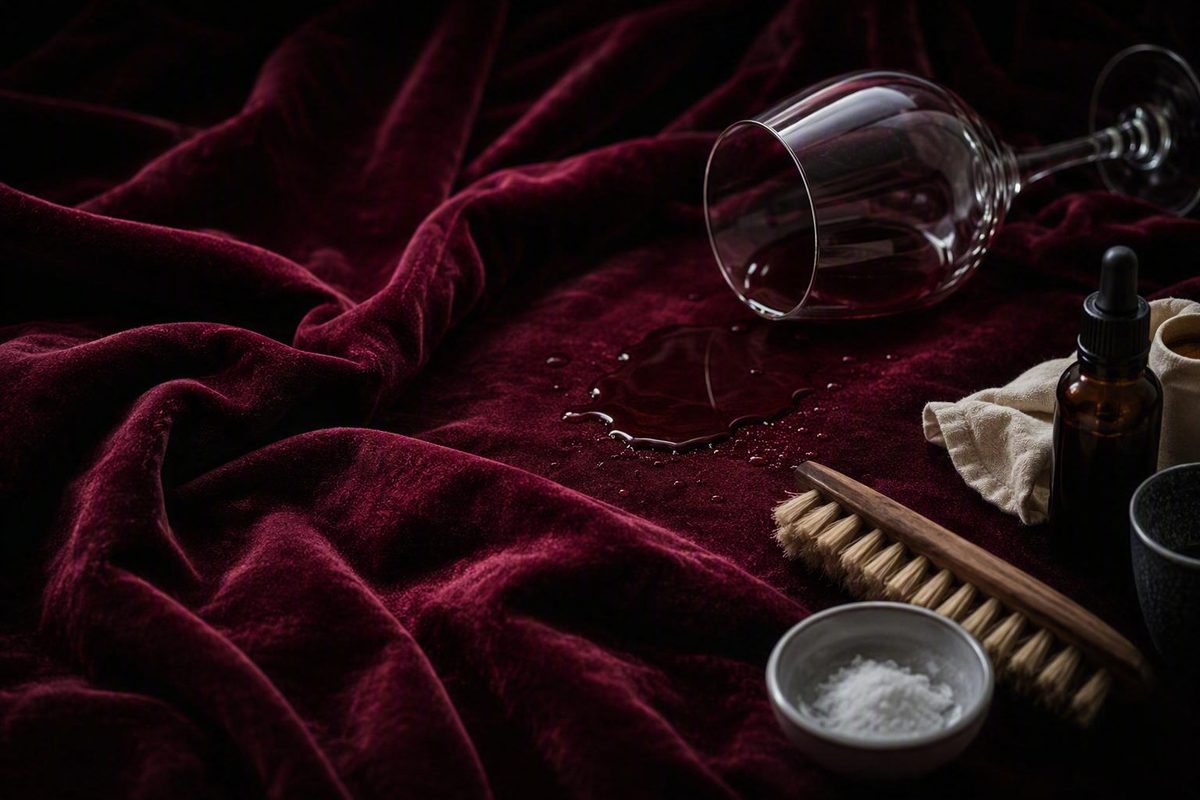
Silk velvet fabric is one of those materials where good stain removal starts with accepting a limit: you are not trying to “attack” the stain so much as reduce it without creating a second problem. With silk, the fiber itself is delicate. With velvet, the raised surface adds another layer of risk. A liquid spill can leave color behind, but heavy-handed cleanup can also leave flattening, drag marks, or a visible patch that looks different from the surrounding nap.
That is why silk velvet usually rewards restraint more than speed-for-speed’s sake. Quick action matters, but the right kind of quick action matters more: blot first, identify the stain family, keep treatments minimal, and stop before you turn one recoverable spot into a larger disturbed area. A stain-by-stain reference such as Stain List’s stain-type index is useful here precisely because wine, oil, and ink do not respond to the same chemistry.
The strongest evidence in this guide is about stain behavior on silk and other delicate protein-based fabrics, with velvet-specific caution added where the raised pile changes the risk of rubbing, saturation, or visible surface disturbance. In other words, the chemistry is well supported; the velvet-specific handling advice is the careful application of that chemistry to a fabric that is structurally less forgiving than a flat weave.
Why Silk Velvet Fabric Stains Differently
Silk velvet fabric stains differently because both the silk and the velvet matter. Silk is a protein fiber, so some stains bind to it more aggressively than they do to cotton or many synthetics. Velvet, meanwhile, is not a plain flat cloth. It has a raised pile surface built through a more complex structure than an ordinary weave. A manufacturer explainer on silk velvet’s pile-and-ground construction describes multiple warps and a distinct pile structure, which helps explain why spot cleaning is riskier here than on a flatter fabric: you are not just cleaning a surface; you are working around a directional, elevated one.
That matters immediately with common household stains. Red wine contains tannins that bind aggressively to protein fibers including silk, while grease and oil are lipids that do not dissolve in water first. So even before you think about “what cleaner should I use,” the stain chemistry has already split into two very different problems. On silk velvet, the wrong first move can either push pigment deeper or spread oil laterally through the pile.
The other difference is methodological. Stain List’s methodology notes say the site starts with methods people are likely to have at home, names temperatures and concentrations when those details change outcomes, and explicitly says when a method is unreliable. That cautious framing is especially important for silk velvet because a method can be chemically reasonable for silk yet still be visually risky on velvet if it requires too much liquid, pressure, or repeat handling.
So the practical takeaway is simple: use silk evidence for chemistry, then scale the force down because the fabric is velvet. That means less rubbing, less saturation, less heat, and less optimism about “one more pass” fixing everything. On sturdier fabrics, persistence sometimes pays. On silk velvet, persistence often becomes the damage.
Immediate Actions for Any Fresh Stain on Silk Velvet
The first step is not cleaning. It is classification. Ask one question right away: is this spill watery and pigmented, or oily and greasy? Wine, juice, tea, and many sauces are handled differently from butter, cooking oil, lotion, or body oil. If you skip that distinction, you can choose the wrong chemistry in the first minute.
A safe first response for almost any fresh spill starts the same way:
- Lift the item, if possible, so the spill does not keep soaking into another layer.
- Blot straight down with a clean, dry, absorbent white cloth or plain white paper towel.
- Rotate to a clean area of the cloth after each press.
- Do not rub, scrub, or drag across the pile.
- Pause and decide what kind of stain you are looking at before adding liquid.
For fresh non-oily liquid stains, the conservative silk protocol is very simple. Stain List’s red-wine guide for silk says to blot with a dry cloth, use cold water only, skip dish soap on silk, never use hot water, and get the item to a cleaner within 2 hours when possible.
For fresh grease or oil, do not follow the cold-water-first route. Oil is the main exception to the “dilute it” instinct. Water first can push lipids deeper into the fibers, so the better first move is blotting and dry absorption. If the spot looks oily, glossy, or translucent, stop before adding water and move to the grease method below.
If the stain is unknown, treat it like an unknown, not like a challenge. Dry blot first. On silk velvet, being slightly slower is usually safer than being slightly stronger.
One more rule belongs in the first five minutes: protect the surface from heat while the stain is still active. Hot water, steam, radiators, hair dryers, and later machine drying all increase the chance that a removable stain becomes harder to shift. For silk velvet, heat is rarely the first answer and often the step that makes later correction less likely.
Removing Red Wine from Silk Velvet Fabric
Red wine is especially troublesome on silk velvet fabric because it combines fresh surface liquid with stain compounds that like protein fibers. Stain List explains that wine’s staining power comes mainly from tannins and anthocyanins: the tannins bind aggressively to silk, and the pigments are water-soluble while fresh but become more resistant after drying, delay, or heat exposure. That chemistry is the reason panic-cleaning goes wrong so often.
For a fresh spill, the safest sequence is still the boring one:
- blot immediately with a dry cloth
- keep pressure light
- use a small amount of cold water only if needed after lifting surface liquid
- do not rub into the nap
- do not start with dish soap
- arrange professional cleaning quickly if the item matters
That sounds almost too minimal, but it fits the evidence. On fresh silk stains, the goal is containment first. If you can reduce how much wine stays in contact with the silk and avoid spreading it, you have already improved the odds. If you rub or over-wet the area, you can create a larger visible patch even before the chemistry has been addressed.
A useful mental model is this: with fresh wine on silk velvet, you are trying to remove what is still loose, not force out what has already started binding. The longer the wine sits, the less cold water alone will do. Once it begins to dry, stronger methods used on sturdier fabrics become more tempting, but that is where silk velvet becomes unforgiving.
For example, peroxide-and-soap formulas can help on some washable fabrics after the first fresh stage has passed. But Stain List warns that peroxide can bleach dark or saturated colors. That does not mean peroxide can never reduce a stain. It means the downside is large enough that valuables, antiques, and dark colors are usually better left to a cleaner.
Salt is also worth demoting from miracle status. It can absorb some surface liquid, but it does not chemically lift the tannins that make red wine persistent. If salt is already on the stain, remove it gently and go back to careful blotting rather than grinding it in.
The hard part of honest advice is admitting where DIY stops being strong. Improvement may still be possible. But with silk velvet, the target often shifts from “erase it” to “lighten it without making the area look handled.”
That is also why timing matters so much. The sooner you lift fresh wine and stop the spread, the more of the problem remains a stain problem rather than a stain-plus-surface problem. Once the nap has been worked, wetted, and reworked, the question is no longer just whether the red is gone. It is whether the fabric still looks like itself.
Treating Grease and Oil Stains on Silk Velvet
Grease and oil stains need a different mindset from wine because water is not the right first chemistry. These stains are lipids. They need absorption first, then a surfactant or solvent if residue remains. In Stain List’s grease-and-oil guide for wool and silk, fresh grease is blotted and covered with an absorbent powder such as cornstarch for 15 to 30 minutes before wet treatment; for silk, any dish soap step is diluted to 1 part soap and 10 parts water, followed by a cold rinse and patting rather than rubbing. The same guide says dry-cleaning solvents are safe on wool and silk and are often the better choice for set stains, and it warns not to machine-dry until the stain is gone because heat can set remaining oil permanently.
Translated to silk velvet, that gives you a careful, low-force routine.
For a fresh oil-based stain 1. Blot off any surface grease gently without spreading it. 2. Cover the area with cornstarch. 3. Let it sit undisturbed. 4. Lift or brush away the powder as gently as possible. 5. If an oily shadow remains, dab with a very dilute dish-soap solution. 6. Rinse lightly with cold water and blot dry.
The goal is upward draw, not agitation. You want the powder to take as much oil as possible before liquid treatment risks spreading it sideways or deeper.
The heavy soap dilution matters for a reason. Straight dish soap may be helpful on sturdy cotton, but silk needs more caution. A diluted solution is easier to control, easier to rinse, and less likely to leave a stiff, draggy patch that changes how the velvet reflects light. On silk velvet, residue can be almost as annoying as the original stain because it alters the hand and can make the nap look different.
Old oil stains are where home treatment becomes a judgment call rather than a recipe. If the stain is large, old, or already heat-exposed, repeated soap attempts can remove some grease while leaving the area increasingly dull or uneven.
Grease also creates a common optical trap. Even when some oil has been lifted, the area may still look darker for a while because it remains damp, partially loaded, or directionally disturbed. That does not mean you should keep scrubbing. Often the safer choice is to let the area dry fully, assess it in normal light, and decide whether the remaining mark justifies another very controlled pass.
If you remember only one rule for oily stains on silk velvet, make it this: absorb first, liquid second. Most DIY damage on grease comes from reversing that order.
Handling Ink Stains on Silk Velvet by Type
Ink is not one stain, and treating it like one is how people make it spread. Stain List’s ink guide by ink family separates ballpoint as oil-based, gel as water-based, and permanent marker as solvent-based, with different removers favored for each.
A practical way to sort the problem:
- Ballpoint ink: often responds to alcohol-based solvent action because the ink vehicle is oil or glycol based.
- Gel ink: often responds better to prompt water-and-soap style treatment while fresh.
- Permanent marker: often needs stronger solvent action, but that also raises the risk on delicate fabric.
The first universal step is blotting, not wiping. Whether the ink is oil-based or water-based, rubbing spreads it laterally.
If you know you have fresh ballpoint ink and the item is not particularly valuable, the least risky DIY attempt is a tiny one. Test the proposed solvent on an inside seam or hidden area first. If the test area shows dye movement, darkening, or a changed sheen, stop. If it does not, use only a barely damp swab or cloth, blot from the outside inward, and change swabs constantly so you do not redeposit dissolved ink back onto the pile.
Gel ink calls for even more restraint. Because water-based inks can move fast when fresh, it is easy to turn a dot into a cloud. Controlled blotting is safer than saturation. If you try any mild wet treatment, the liquid should be minimal and the pressure lighter than feels intuitive.
Permanent marker is where “possible” and “wise” diverge. The odds of a perfect home result go down fast once a solvent-driven stain has spread or partially dissolved.
The correct answer depends on the ink type, how fresh it is, how stable the fabric dye is, and how much risk you are willing to accept. That is not vagueness. It is the chemistry talking.
Set Stains and Limitations on Silk Velvet
Set stains are where expectations need the most adjustment. Once a stain has dried, oxidized, or been heated, removal becomes less reliable. Stain List’s grease guidance says machine drying can set remaining oil permanently. Its red-wine guidance says heat and delay make stain compounds increasingly resistant.
That produces a double limitation. First, the stain itself may be harder to remove. Second, even partial success can leave a spot that still reads visually because the pile no longer reflects light like the surrounding area.
That is why older silk velvet stains should be judged by better questions than “Will it come out?”
Ask instead:
- Can it improve enough to be less noticeable?
- Can it improve without expanding the visible area?
- Can it improve without shifting color?
- Can it improve without leaving the pile flatter or rougher?
- Would a failed home attempt cost more than the remaining stain?
Those questions are not pessimistic. They are practical. A small, old stain on an inexpensive item may be worth a cautious home try. A larger set stain on a dark, valuable, or sentimental item usually is not. The older the stain, the more prior attempts matter too. A spot that has already seen water, soap, heat, rubbing, or multiple cleaners is no longer the “original stain.” It is a changed site with its own new risks.
There is also no honest guarantee language to offer here. Stain List’s terms note on completeness and liability says the material is for general reading, makes no warranty as to completeness, and does not assume liability for decisions made from the content. That is legal framing, but it also matches reality: stain outcomes vary by age, fiber behavior, prior treatment, temperature exposure, and dye stability.
So yes, some old stains can improve. But improvement and invisibility are different outcomes, and silk velvet punishes anyone who confuses them.
General Care Tips to Protect Silk Velvet from Stains
The best stain removal strategy for silk velvet fabric starts before the stain happens. Prevention here is less about special products and more about reducing the odds that you will need aggressive spot cleaning later.
First, test before you trust. A hidden-area test does not guarantee safety, but it tells you whether the fabric reacts badly right away. That is especially important on delicate fabrics where dye movement, darkening, or a changed sheen can matter as much as the stain itself.
Second, store and handle silk velvet in ways that protect the pile. Avoid hard folding when possible, avoid stacking heavy objects on top of it, and avoid leaving it crushed in storage. A spill on already-compressed velvet is harder to read accurately and easier to overwork during cleanup because the surface is already visually uneven.
Third, keep your home process cold, gentle, and incremental. Pat instead of rub. Blot instead of scrub. Use the least liquid that can reasonably do the job. If you feel tempted to flush the area under a tap, soak the whole section, or “just give it a stronger second round,” that is often the moment to stop and reassess.
Fourth, work like you are climbing a ladder rather than making a leap. Start with dry blotting. If the stain is watery and fresh, use minimal cold-water dilution. If the stain is oily, absorb first. Add chemistry only when the stain type supports it, and keep the chemistry as mild and targeted as the evidence allows. That mirrors the way Stain List frames its practical stain-removal method: start with common tools, be exact when details matter, and say plainly when a method is not reliably safe.
Finally, remember that “gentle” and “too much” can coexist. Even gentle treatment becomes aggressive when repeated many times on velvet. The safest home cleaner is often the person who knows when to stop.
Common Mistakes That Ruin Silk Velvet Fabric
The biggest mistake is rubbing. Rubbing spreads liquid through the pile, enlarges the boundary of the stain, and can leave the treated patch looking different even if some of the stain lightens. On velvet, a rubbed area may stay visible because its surface direction has changed, not because much stain remains.
The second mistake is treating all fresh stains as if they were water-based. That is exactly backwards for grease and oil. If you rush to rinse an oily spot, you can drive the lipid deeper before you have given an absorbent powder any chance to pull it out.
The third mistake is using stronger cleaner too soon. Fresh red wine on silk is not supposed to start with dish soap. Fresh grease on silk is not supposed to start with undiluted soap. Ink is not supposed to start with a random all-purpose remover if you do not even know what type of ink it is. When people say a fabric “didn’t tolerate cleaning,” the problem is often that the chemistry did not match the stain.
Heat is especially damaging because it can make a partially improved stain permanent while also changing how the velvet surface looks.
The fifth mistake is over-wetting. Velvet does not need much moisture to look uneven while it dries. A large damp halo can become its own visual problem, especially if the original stain was smaller than the area you saturated.
The sixth mistake is chasing a perfect home result long after the odds have turned. If the stain is improving only slightly while the pile looks flatter, rougher, or more reflective than the surrounding fabric, you are no longer winning. Stopping is part of good technique.
When to Seek Professional Help for Silk Velvet
Professional help is the right first move, not the last resort, when the item is valuable, antique, darkly dyed, tailored, structured, lined, padded, embroidered, or emotionally irreplaceable. It is also the safer choice when you do not know what caused the stain. Silk velvet gives you very little room for trial and error.
You should also stop DIY and hand the piece off if any of the following happens:
- the stain has dried or gone through heat
- a hidden test area changes color or sheen
- blotting begins to lift dye
- the pile starts to mat or flatten
- the stain is larger than a tiny controlled test area
- you suspect more than one stain type is present, such as wine plus butter or makeup plus body oil
- earlier attempts have already involved soap, water, solvent, or heat
A professional cleaner may not promise full removal either, but they are better positioned to choose between wet treatment and solvent treatment, control how much moisture is used, and finish the surface without adding obvious pile damage. On silk velvet, that downside protection is often what you are paying for.
It also helps to think clearly about the cost of being wrong. On a washable towel, a failed home attempt is annoying. On silk velvet, a failed attempt can create dye loss, a ring, a larger stain boundary, or a crushed-looking patch that draws more attention than the original spill. That is why “Can I try one thing first?” is not always the best question. Sometimes the better question is “If this goes badly, what will I wish I had done?”
If the honest answer is “I’ll wish I had taken it in immediately,” then you already know what to do.
Can I use dish soap on fresh red wine spilled on silk velvet?
Not as your first move. For fresh red wine on silk, the supported immediate response is dry blotting followed by cold water only, while skipping dish soap at that first stage and getting the item to a cleaner quickly when it matters. That is the safer silk-first protocol reflected in Stain List’s red-wine guidance.
Is hot water ever safe for grease on silk velvet fabric?
As a DIY starting point, assume no. The supported wool-and-silk method uses diluted soap and a cold rinse, and heat raises the risk that any remaining oil will set more stubbornly once the item dries. For silk velvet, hot water is not the conservative choice.
What powder absorbs oil best before treating silk velvet?
Cornstarch is the most practical first choice for home treatment. Stain List lists cornstarch, talc, and baking soda as absorbent options, but cornstarch is usually easiest to apply and remove gently from a velvet surface without turning cleanup into aggressive brushing.
Does salt work on wine stains in silk velvet pile?
Not very well. It can absorb some surface liquid, but it does not chemically lift the tannins that make red wine persistent. On velvet, it also leaves residue that can tempt damaging brushing or rubbing during cleanup.
Are DIY methods guaranteed for set ink on silk velvet?
No. Older ink stains on delicate fabrics vary too much by ink type, age, prior treatment, and fabric response for any honest guarantee. Stain List’s terms make that legal point explicitly, but the practical point is the same: once ink is set, prediction gets weaker and the cost of a failed attempt goes up.