 StainList
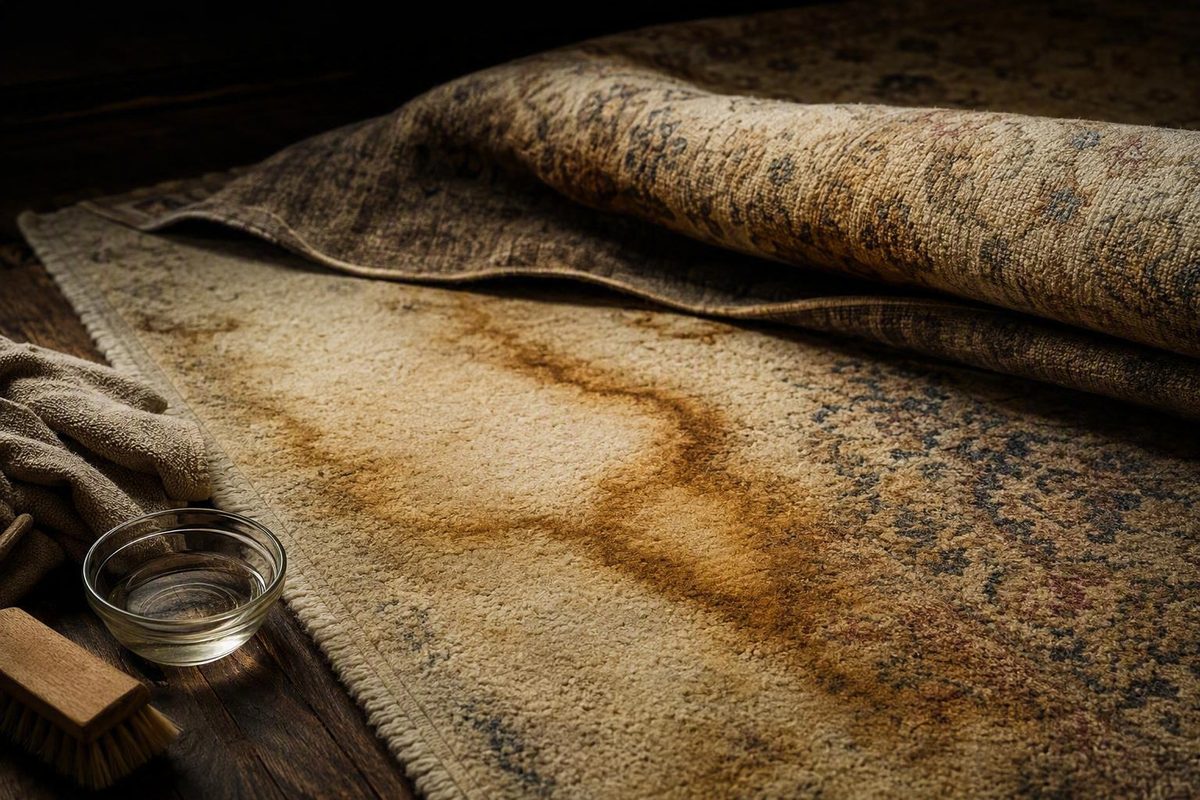
If a rug turns yellow-brown a day after spot cleaning, stop wetting it, blot any remaining surface moisture, and let it dry with ordinary airflow. A diluted acid rinse may correct a small, dry, colorfast spot on a known, low-value rug when its care instructions permit acidic treatment. Do not try it on wool, viscose, sisal, handmade, adhesive-backed, valuable, unstable, or unidentified rugs. Persistent dampness, odor, dye transfer, distortion, or widespread discoloration requires a rug specialist.
Brown returning during drying may be cellulosic browning, but it may also be soil or detergent wick-back, alkaline yellowing, mineral residue, dye migration, or permanent color loss. Diagnosis matters because adding another cleaner can remobilize the material causing the mark.
Choose the rug construction, cleaning history, and warning signs; the tool gives a treatment verdict and calculates the cited vinegar ratio.
Select what is known. The default conservative verdict is to dry the rug and avoid adding chemistry.
Blot accessible moisture, use ordinary airflow, and do not add another cleaner until the construction and cause are known.
The cited commercial ratio is 1 part white vinegar to 4 parts water. This calculator does not establish that vinegar is safe for your rug.
Do not use an improvised vinegar rinse on wool, viscose, sisal, handmade, adhesive-backed, unstable, valuable, or unidentified rugs.
| Observed Situation | Construction | Verdict | Reason |
|---|---|---|---|
| Still damp or musty | Any | Call A Pro | Internal moisture or odor needs controlled assessment. |
| Dye transfers or colors spread | Any | Call A Pro | More liquid can worsen dye migration. |
| Shape or texture changed | Any | Call A Pro | Curling, shrinkage, or distortion signals structural risk. |
| Brown tips after slow drying | Known low-risk, replaceable rug | Acid Rinse May Qualify | Only if acidic treatment is expressly permitted and a dry test passed. |
| Yellowing after alkaline cleaner | Known low-risk, replaceable rug | Acid Rinse May Qualify | A compatible acidic correction may neutralize residue. |
| Original dirty spot returned | Any | Dry Only | Wick-back may require controlled extraction, not another spot spray. |
| Chalky, dull, or stiff patch | Any | Dry Only | Cleaner or mineral residue may be present. |
| Lighter or faded area | Any | Call A Pro | An acid rinse cannot restore missing dye. |
| Brown mark on wool pile | Cotton or jute foundation | Call A Pro | Hidden cellulose can brown, but improvised vinegar is not advised on wool. |
| Any post-cleaning mark | Viscose, sisal, handmade, adhesive-backed, or unknown | Call A Pro | Fiber, dye, backing, or dimensional risks are too high. |
Sources: Wirecutter guidance on cellulosic browning; Cleanfax, “Correction without Destruction”; commercial 1:4 vinegar guidance cited in the article.
Blot, Dry, And Stop Before Adding Chemistry
When discoloration appears, stop spraying, rinsing, or spot-cleaning. Do not scrub or brush the area. Press clean white towels gently against accessible moisture, without rubbing, and keep people and pets off the rug.
Photograph the spot, the whole rug, its reverse, fringe, and care label. Record what product was used, its dilution if known, how it was removed, when the mark appeared, and whether the backing remains damp. If a professional performed the cleaning, contact that cleaner before applying vinegar, peroxide, detergent, or an anti-browning product.
Use room ventilation, ordinary airflow, and dehumidification rather than concentrated heat. Do not aim a hair dryer or space heater at the spot. Prompt drying generally reduces migration when cellulose, excess moisture, and slow drying are involved, although the directions for a corrective product already on the rug take precedence. Some treatments specifically require air-drying without rinsing or accelerated drying, which is why the exact label controls (Kleenrite’s product directions).
Stop home treatment if the rug remains damp internally, smells musty, transfers dye, ripples, curls, shrinks, stiffens, develops fuzzing, or changes texture. Widespread, expanding, or recurrent discoloration also belongs with a rug specialist.
Cellulosic Browning Moves Upward As The Rug Dries
True cellulosic browning occurs when moisture reaches cellulose-containing material and mobilizes naturally colored, often lignin-related material. As water moves toward an evaporating surface, it can carry this color from a fiber, foundation, or backing. The water disappears during drying, leaving a tan, yellow-brown, brown, or occasionally reddish cast at the surface.
The usual combination is a cellulose-containing component, enough moisture to mobilize color, and drying slow enough to allow migration. Overwetting, high humidity, inadequate airflow, cleaner residue, and alkaline cleaning chemistry are commonly cited contributing conditions. Browning often becomes most visible at pile tips, raised areas, seams, and fringe, where evaporation occurs (Agar Cleaning Systems).
This delayed appearance is why a cleaned spot can look fine at first and return the next day. Residual soil or detergent can travel upward by a similar process. In true cellulosic browning, the transported color comes from cellulose-containing material rather than ordinary soil alone.
Higher-pH conditions are commonly associated with more pronounced browning. There is no universal pH threshold or household formula that is safe across rug fibers, dyes, backing materials, adhesives, and residues. More wet cleaning can restart capillary movement and enlarge the mark if extraction or drying remains inadequate.
Hidden Cotton Or Jute Can Brown A Wool Rug
Cotton, linen, jute, sisal, hemp, viscose, and some forms of rayon contain cellulose. Wool does not contain cellulose or lignin, but a wool-faced rug can still brown when moisture reaches jute backing, cotton foundation yarns, cotton fringe, or another hidden cellulose component.
Synthetic face fibers do not rule it out either. Nylon, polyester, or polypropylene pile may sit over jute backing or cotton foundation yarns. A cellulose-containing pad or nearby wood may also provide a source when moisture passes through the rug system (Actichem’s affected-fiber guide).
Inspect more than the visible pile:
- The fiber-content and care labels
- The rug’s reverse and exposed foundation yarns
- Fringe and edge finishes
- Secondary backing, latex, adhesive, or nonslip coatings
- The pad and floor beneath the rug
- Purchase records or maker specifications
A label describing a rug as “100% wool” may refer only to its face yarn. Viscose may appear under another marketing name, and foundation materials can remain concealed. Use particular caution with viscose, sisal, cotton, aged jute, handmade rugs, unstable dyes, and adhesive-backed construction.
The Mark’s Pattern Separates Browning From Similar Damage
Several post-cleaning problems create yellow or brown marks, but their remedies are not interchangeable.
| Likely Cause | Typical Pattern | Supporting Clues | Safest Response |
|---|---|---|---|
| Cellulosic browning | Brown cast at tips, seams, fringe, or raised pile | Cellulose is present; rug was wet or slow to dry | Dry, identify construction, then assess correction |
| Soil or detergent wick-back | Original spot returns during drying | Spill, soil, or cleaner remains below the surface | Avoid resaturation; controlled extraction may be needed |
| Alkaline yellowing | Local or general yellow cast | Alkaline cleaner or residue was used | Identify chemistry before acidic correction |
| Dye migration | One color spreads into another | Color transfers; outlines blur | Stop and call a rug specialist |
| Mineral or cleaner residue | Pale, chalky, dull, or stiff patch | Product was overapplied or incompletely removed | Do not layer on another cleaner |
| Chemical color loss | Lighter, orange, yellow, or faded patch | Bleach or oxidizer exposure | Cleaning cannot replace missing dye |
| Ultraviolet fading | Gradual fading near windows | Covered areas retain stronger color | Consider color correction or replacement |
Industry guidance distinguishes cellulose-related browning, alkaline yellowing, and soil wicking while noting that “browning” is sometimes used too broadly for any discoloration appearing after drying (Aramsco’s comparison).
Pressing a nearly dry white towel against the area can provide one clue. Brown transfer may indicate surface soil or residue, but it is not conclusive: unstable dye, degraded fiber, and treatment residue can also mark the towel. If a rug color transfers, stop.
A lighter area may be missing or altered dye rather than coated with removable material. Bleach, oxidizer damage, and sunlight fading cannot be reversed by an anti-browning rinse. The remaining options may be professional dye correction, patching, concealment, or replacement.
A Home Acid Rinse Is Limited To Low-Risk Rugs
Home correction is reasonable only when the affected area is small, the rug is replaceable, every part of its construction is known, the rug is completely dry and structurally unchanged, and no color transfers to a white towel. Its care instructions or the corrective product’s label must expressly approve the fibers and intended use.
Before treatment, read the complete label and safety data sheet if available. Confirm the approved fibers, exclusions, dilution, application method, dwell time, removal method, drying requirements, ventilation, and protective equipment. “Carpet and upholstery” on a package does not establish suitability for a handmade rug, viscose, sisal, wool, cotton fringe, unstable dyes, or adhesive backing.
Test an inconspicuous corner exactly as directed. Let it dry completely, then check for dye transfer, fading, stiffness, fuzzing, curling, shrinkage, rings, halos, or renewed browning. If the test passes, use the minimum moisture allowed by the label. Do not scrub, saturate, or keep reapplying because the result seems slow.
There is no universal rule that an anti-browning treatment should be rinsed, extracted, blotted, or left in place. Those instructions depend on its formulation. One product’s directions cannot be transferred to another.
The Cited Vinegar Ratio Is One Part To Four Parts Water
A commercial cleaning guide suggests one part white vinegar to four parts water for suspected browning (COIT’s discoloration guide). That is a commercial recommendation, not evidence that the mixture is safe for every rug.
Do not improvise this vinegar rinse on wool, viscose, sisal, handmade rugs, unstable dyes, adhesive-backed rugs, unknown constructions, or rugs whose care instructions do not permit it. A spot application may create an uneven correction or visible boundary even when the fibers tolerate the solution.
An acidic treatment can neutralize alkaline residue or make lignin-related discoloration less visible without removing its source. If colored material remains in the backing or foundation, later moisture may bring the mark back. Temporary improvement does not prove that the underlying material is gone.
Never substitute chlorine bleach, ammonia, a strong alkaline cleaner, unlabeled peroxide, a reducer, or an oxidizer. Do not soak the area or combine products unless a manufacturer’s directions expressly describe the complete system.
Professional Correction Uses A Controlled Risk Ladder
A professional first distinguishes browning from wick-back, alkaline yellowing, residue, dye migration, and color loss. The cleaner then identifies the pile, dyes, foundation, backing, adhesive, and previous chemistry before choosing a correction.
The usual risk ladder is compatible acidic correction first, followed only when necessary by more aggressive reducing or non-chlorine oxidizing chemistry. A professional discussion of upholstery describes this sequence as correction without destructive escalation. It warns that repeated cleaning can alter texture, reducers can create odor and powder residue, and oxidizers can over-whiten, weaken, or distort a textile (Cleanfax’s procedure). The procedure is not a homeowner rug recipe.
Choose an experienced in-plant rug-cleaning specialist for handmade, antique, valuable, silk, viscose, sisal, cotton, aged-jute, adhesive-backed, or dye-unstable rugs. Professional assessment is also warranted when construction is unknown, browning is widespread or recurrent, the backing remains damp, an odor develops, dye transfers, or the rug changes shape or texture.
Give the specialist photographs of the front, back, fringe, label, and affected area. Include every product used, known dilution, application method, cleaning time, approximate drying conditions, and the point when discoloration appeared.
Complete removal is not guaranteed. Deteriorated backing may continue releasing color, weak fibers may not tolerate repeated correction, and missing dye cannot be washed back into place.
Prevention Depends On Moisture Removal And Full Construction
Before another wet cleaning, identify the face fiber, foundation, backing, fringe, adhesive, and latex layers. Test significant colors for stability and review the maker’s care instructions.
Use limited, even moisture appropriate to the construction rather than saturating the pile and backing. Choose compatible, controlled-pH chemistry and avoid leaving detergent residue. When the method permits extraction, remove the solution thoroughly and make additional dry extraction passes.
Plan ventilation, airflow, and dehumidification before wetting the rug. Air should circulate around the rug rather than heating one isolated spot. Sensitive natural-fiber, handmade, viscose, sisal, aged, valuable, or dye-unstable rugs are generally safer in an in-plant facility where extraction, grooming, dye movement, and drying can be controlled.
Wool Pile Does Not Exclude Cellulosic Browning
Wool itself is not the cellulose source. Browning can come from jute backing, cotton foundation yarns, fringe, a blended component, a pad, or another material reached by moisture. Wool rugs can also experience alkaline yellowing, dye movement, and soil wick-back, so the color alone does not establish the diagnosis.
Returning Brown Marks Point To Material Below The Surface
A wet spot may temporarily look clear, then carry lignin-related color, soil, or detergent upward as it dries. An acidic treatment may also lighten the visible discoloration without removing material in the backing. If the mark repeatedly returns, stop spraying and have the residue load, construction, and drying conditions assessed.
Anti-Browning Products Follow Their Own Rinse Directions
Some products are applied lightly and left to dry. Others require blotting, rinsing, or compatible extraction. Follow the exact label, including its drying instructions, and do not use a product that fails to identify approved materials and removal requirements.