 StainList
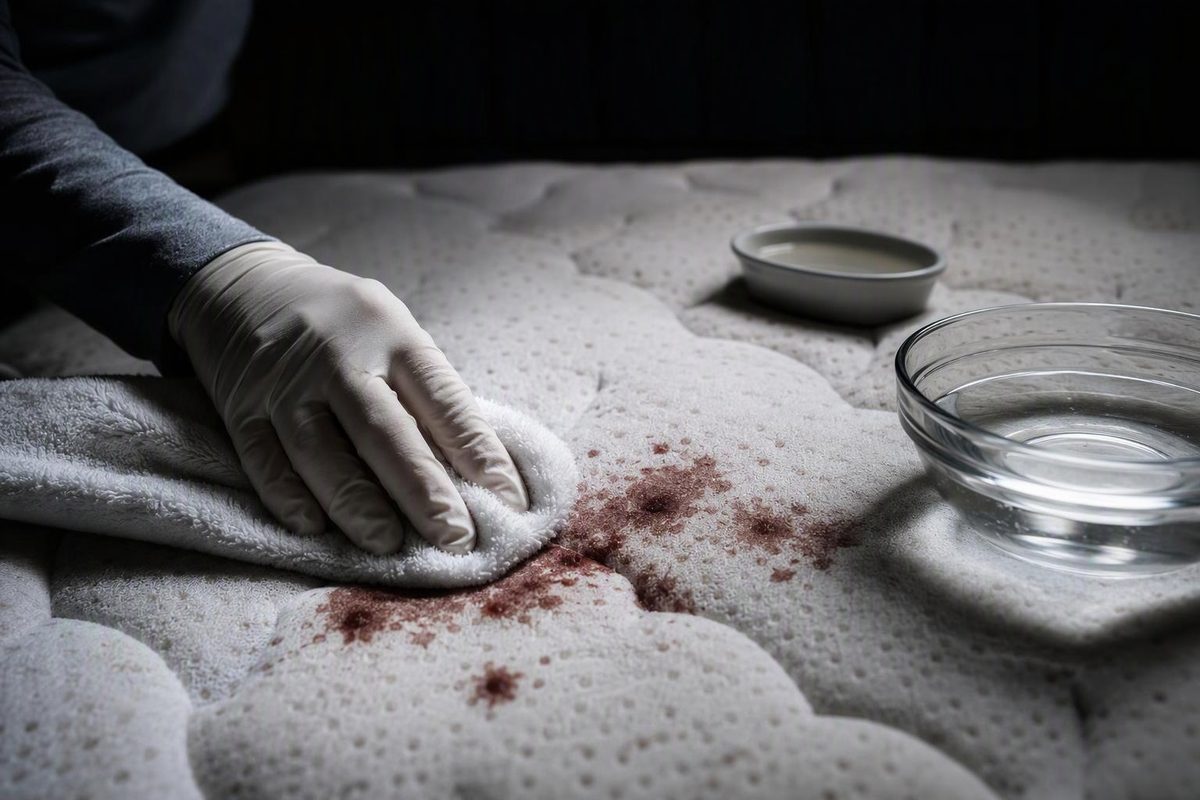
Use cool water, a white cloth and very little moisture. Blot fresh blood first; if color remains, use a small amount of diluted liquid detergent. For a dried mark, soften it gradually and consider a protease-based upholstery cleaner only if its label permits use on the mattress fabric.
Do not pour water or cleaner onto the mattress. Excess liquid can carry blood into the padding and make the mattress difficult to dry.
Check the mattress before treating it
- Read the care label and manufacturer’s instructions. A zipper does not necessarily mean the cover is removable or washable. Tempur-Pedic permits cold washing of certain removable covers but says to spot-clean non-removable covers without saturating them and never soak its foam material (Tempur-Pedic). Sleep Number tells owners not to remove or machine-wash its mattress cover and to use only enough water to lightly dampen a spot (Sleep Number). Follow the directions for your model.
- Wear household gloves if the blood is not yours and avoid contact with broken skin, eyes and mouth. CDC blood-exposure guidance recommends protective barriers where contact with blood may occur (CDC).
- Patch-test the cleaner. Apply it to a hidden seam with a white cloth, blot with a barely damp cloth and let the test area dry. Stop if dye transfers, the fabric lightens or its texture changes.
For a fresh blood stain
You will need cool water, clean white cloths, liquid laundry detergent and dry towels.
- Remove the sheets and protector without pressing them against the mattress. Treat washable bedding separately using How to Get Blood Out of Clothes.
- Press a dry white cloth onto the blood. Lift it and move to a clean section as blood transfers; do not rub.
- Dampen—not soak—a fresh cloth with cool water. Blot from the outside edge toward the center, alternating with a dry cloth to draw the diluted blood back out.
- If color remains and the care instructions allow water-based spot cleaning, mix 1/8 teaspoon of liquid laundry detergent with 1 cup (240 mL) of cool water. Put the solution on a cloth, not directly on the mattress, and blot the mark. This is equivalent to the mild detergent dilution in the University of Georgia’s guidance for natural-fiber upholstery (UGA Extension).
- Blot with a separate cloth barely dampened with plain cool water to remove detergent, then press firmly with dry towels.
Cool water is the conservative starting point for blood. The American Cleaning Institute advises cold-water treatment for fresh blood and warns that hot water can set the stain (ACI). UGA’s upholstery guidance also calls for cool water and warns that overwetting can leave a ring.
For dried or stubborn blood
- Hold a cool, damp cloth against the mark briefly to soften it, checking often. Do not flood the area or scrape the mattress fabric.
- Blot with the diluted detergent solution above, then blot-rinse with minimal plain water. Repeat only while blood continues to transfer to the cloth and the mattress is not becoming wet below the surface.
- If the stain remains, choose an enzyme cleaner labeled for upholstery and compatible with the mattress cover. Protease is the enzyme used for protein-based stains such as blood, but products differ; follow the product’s contact-time, application and rinsing directions rather than improvising (American Cleaning Institute). This guide to choosing an enzymatic cleaner for blood explains what to check.
- Stop if the product requires enough liquid to soak the mattress. Do not layer enzyme cleaner, peroxide, ammonia, chlorine bleach or other stain removers.
If the mattress has a removable, washable cover, clean that cover separately according to its care label. Stronger laundry treatments that require soaking or thorough rinsing belong on a confirmed-washable cover, not on foam or a fixed mattress surface.
Dry the mattress completely
Press the treated spot with folded dry towels, then leave the bed uncovered with a fan blowing across the surface. Do not remake the bed until the area feels dry and no cool, damp patch remains. Tempur-Pedic likewise recommends complete air-drying after spot treatment and suggests a fan to speed the process (Tempur-Pedic). Avoid a hair dryer, steam cleaner or other heat.
A faint brown or yellow shadow after drying may not respond to further surface treatment. Repeated wetting is more likely to leave a water ring or dampen the foam than to remove a deeply set mark. Stop if the mattress develops an odor, the mark returns from below, the foam became wet, or the cover changes color or texture.
Stain removal is not the same as disinfection. If a substantial amount of another person’s blood soaked into the mattress, surface blotting cannot reliably treat the inner porous material; seek professional biohazard-cleaning advice or consider replacement.