 StainList
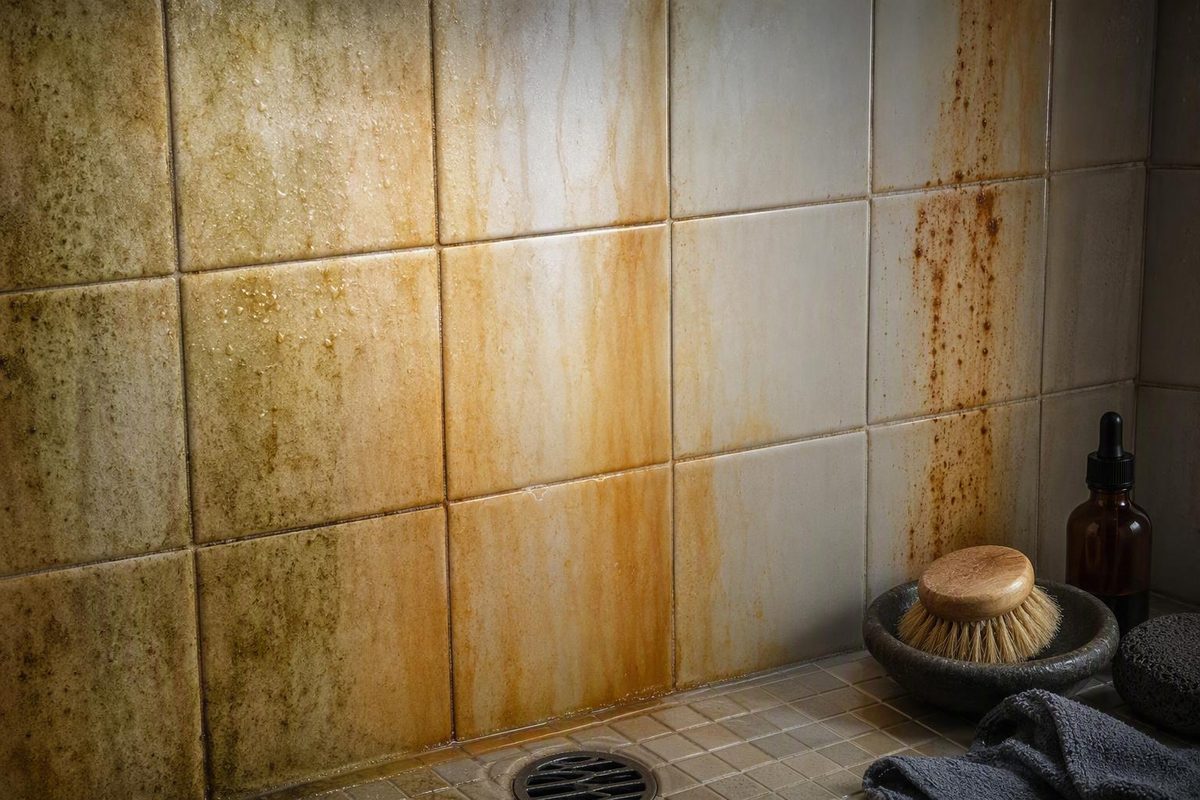
Orange stains in a shower are a symptom, not a diagnosis. A slimy film in persistently damp corners is consistent with microbial growth. Widespread orange-red marks where droplets dry suggest waterborne iron. A ring beneath a can, razor, caddy, drain, or fixture suggests transferred rust or local corrosion. Identify the shower material first, clean gently, rinse and dry, then choose one surface-compatible treatment based on the pattern—not the color alone.
Quick answer: diagnose the pattern before treating the stain
Do not assume every orange mark is mold, hard-water scale, or rust. Several unrelated materials can overlap in color, so texture, location, distribution, and recurrence provide better clues.
| Appearance or texture | Distribution | Likely explanation | Next step |
|---|---|---|---|
| Slimy pink-orange film | Damp corners, grout lines, drains, curtain folds, or areas around soap and shampoo residue | Consistent with microbial growth; color does not identify the organism | Remove ordinary residue, then use a material-approved antimicrobial bathroom cleaner |
| Orange-red spots or streaks | Widespread wherever droplets dry, possibly at sinks and toilets too | Suggests iron carried by the water | Use a compatible rust remover and investigate the water if staining recurs |
| Object-shaped ring or localized streak | Beneath a can, razor, caddy, soap dish, drain, or fixture | Suggests transferred rust or nearby corrosion | Remove the object, inspect the metal, and treat the remaining mark as rust |
| Waxy orange, yellow, gray, or white film | Areas where body-care products and water collect | May be soap scum holding other discoloration | Start with a material-approved soap-scum cleaner |
| Hard white-gray crust | Showerheads, glass edges, faucets, and repeated drying zones | More characteristic of calcium-rich scale | Treat separately with a surface-compatible descaler |
Municipal homeowner guidance similarly distinguishes moisture-related orange discoloration, iron-related rust colors, and primarily white-to-gray crusty mineral deposits rather than treating them as one problem (DeSoto’s guide to stains and mineral deposits).
Before cleaning, note:
- whether the mark feels slimy, waxy, crusty, or smooth;
- whether it appears at other sinks, toilets, or appliances;
- whether cold tap water itself looks discolored;
- how quickly the residue returns after cleaning and drying;
- whether it sits directly below a metal object or fixture;
- whether the home uses municipal water or a private well.
Do not identify a microbial-looking film as Serratia marcescens by sight. Orange or pink color alone cannot distinguish a particular bacterium from mold, pigment, soap residue, or mixed buildup. Likewise, an orange stain is not proof of iron-rich water unless its distribution, recurrence, or water testing supports that explanation.
Use this lowest-risk-first cleaning workflow
The goal is to remove loose buildup without scratching the surface, altering its finish, or creating a chemical hazard. Do not begin with the strongest cleaner available.
-
Identify the material and finish. Determine whether the surface is acrylic, fiberglass, glazed tile, grout, glass, porcelain, natural stone, metal, or a refinished coating. Check the shower manufacturer’s care instructions and the cleaner label before applying anything.
-
Remove movable metal items. Lift cans, razors, caddies, soap dishes, and other accessories. Inspect them—as well as drains, fixtures, fasteners, and connections—for corrosion matching the stain’s shape or position.
-
Clean gently. Use the mildest routine cleaner approved for the material, applied with a soft cloth, non-scratch sponge, or soft-bristle brush. Do not start with strong acid, bleach, abrasive powder, steel wool, pumice, sandpaper, or an improvised chemical mixture.
-
Rinse and dry. Remove the cleaner and loosened soap residue completely, then dry the surface. Reassess the remaining color only after the area is clean and dry.
-
Choose one targeted treatment. If discoloration remains, select a soap-scum cleaner, antimicrobial bathroom product, rust remover, or descaler according to the evidence. Do not layer treatments.
-
Spot-test and follow the label. Test an inconspicuous area, use the specified protective equipment and contact time, rinse as directed, and stop if the surface becomes dull, sticky, softened, etched, or discolored.
Failure to remove the mark does not justify progressively harsher scrubbing. Additional abrasion may remove or dull the finish rather than remove the stain.
Choose the treatment that matches the likely cause
For suspected microbial film: Remove soap, shampoo, and other organic residue first. Organic material can reduce the performance of hypochlorite disinfectants. If both the shower manufacturer and product label permit it, apply a chlorine-based or other antimicrobial bathroom cleaner according to the product’s dilution, contact-time, ventilation, and rinsing instructions. CDC technical guidance confirms that hypochlorite performance depends on concentration, contact time, pH, and organic matter, but that healthcare guidance is not a household shower-cleaning recipe (CDC guidance on chemical disinfectants).
Continue to describe the material as “microbial-looking residue” unless laboratory analysis establishes the organism.
For likely waterborne iron or transferred rust: Use a cleaner specifically labeled for rust removal and approved for the exact surface. Oxalic-acid cleaners are one product category marketed for shower rust, but compatibility varies by formula and material. Manufacturer instructions for one such cleaner, for example, exclude natural stone and require spot testing and complete rinsing (manufacturer instructions for an oxalic-acid rust cleaner).
Bleach is not a universal orange-stain treatment and should not be the primary choice for suspected iron or rust. Its antimicrobial action does not make it a rust remover.
For waxy soap residue: Use a material-approved soap-scum cleaner. Soap scum may appear orange, yellow, gray, or white, so tint alone does not prove rust or biological growth.
For white-gray crust: Treat it as a separate scale problem. Confirm that the descaler is approved for the shower surface, fixtures, grout, and sealants. A product suitable for ordinary glass or glazed ceramic may not be suitable for stone or a specialty metal finish.
Avoid universal homemade recipes and guessed concentrations. Vinegar, lemon, baking soda, peroxide, chlorine bleach, and commercial acids all have limitations. Combining familiar household ingredients does not make them universally safe. Follow one product label at a time.
Match the cleaner to the shower material
A cleaner can match the suspected stain and still damage the shower. This is a caution guide, not a complete compatibility chart; the shower and cleaner manufacturers’ instructions control.
| Surface | Main cautions | Conservative approach |
|---|---|---|
| Acrylic or fiberglass | Abrasives can scratch or dull the finish; incompatible cleaners may affect the surface | Use non-abrasive tools and short, label-directed exposure |
| Tile and grout | Tile, grout, caulk, sealant, and decorative finishes may react differently | Test each component and avoid aggressive scrubbing on porous or deteriorated grout |
| Glass and metal finishes | Abrasives may scratch; specialty coatings and plated finishes vary | Use soft tools and verify compatibility with every coated or metal component |
| Marble, travertine, and acid-sensitive stone | Acids and unapproved rust removers can etch the surface | Use stone-approved products or consult a stone-care specialist |
| Unknown, damaged, patterned, or refinished surfaces | The visible layer may not tolerate standard shower cleaners | Stop after gentle cleaning until the material or coating is identified |
For acrylic and fiberglass, avoid sandpaper, steel wool, pumice, and harsh scouring powders unless the manufacturer expressly approves them. Municipal homeowner guidance warns that abrasive tools can scratch protective finishes and make surfaces more susceptible to later staining or growth (DeSoto’s surface-care guidance).
For tile and grout, identify the tile separately from the grout, caulk, sealant, metallic trim, and printed decoration. Porous grout may retain color after the tile is clean.
For glass and metal, use soft tools and account for coatings. Concentrated chlorine can corrode some metals, while abrasive products may scratch glass, stainless steel, or plated fixtures. Confirm compatibility before allowing a cleaner to contact adjacent hardware.
For marble, travertine, and other acid-sensitive stone, do not use vinegar, lemon juice, CLR-type acidic products, or an unapproved rust remover. Acid can etch these surfaces and leave a dull area that cleaning will not reverse; shower-care guidance also specifically warns that vinegar and lemon can etch marble and travertine (surface-specific rust-cleaning guidance).
For an unknown or refinished surface, do not experiment with aggressive chemistry. Gentle routine cleaning is the stopping point until you identify the material or coating.
Chemical safety rules that override every cleaning recipe
Warning: Never mix chlorine bleach with vinegar, lemon juice, other acids, ammonia, rust removers, or any other cleaning product.
Mixing hypochlorite bleach with acids or ammonia can release hazardous gases. Bleach can also irritate eyes and tissue, corrode metals, discolor fabrics, and damage some sealants and finishes even when used alone. These hazards are documented in the CDC’s technical overview of hypochlorite disinfectants.
If you do not know what was previously applied, stop and consult the product labels or manufacturers before proceeding.
For any chemical treatment:
- ventilate the bathroom as directed by the label;
- wear the specified gloves, eye protection, or other equipment;
- avoid splashing skin, eyes, clothing, and nearby metals;
- use only the directed amount and contact time;
- rinse and dispose of residue as instructed;
- follow label directions for keeping people and pets away from the treated area.
Do not attempt to neutralize the mixture yourself.
Prevent the orange residue from returning
Prevention depends on the source.
For moisture-related film, remove soap and shampoo residue regularly, improve ventilation, and wipe or squeegee wet surfaces after use. Pay particular attention to curtain folds, grout joints, drain edges, bottle shelves, and corners that stay damp.
For localized rust, remove corroding cans, razors, caddies, and soap dishes. Inspect drains, fixture bases, fasteners, and supply connections.
For widespread iron staining, repeated surface cleaning will not correct iron-bearing water or corroding plumbing.
Document persistent problems with:
- photos showing the stain’s location and pattern;
- the date and method of cleaning;
- the time required for the stain to return;
- its texture, odor, or sheen;
- whether hot and cold water behave differently;
- other affected fixtures.
This record can help a homeowner explain the pattern to a plumber, utility, or water professional. Renters can use it when reporting a recurring water or plumbing issue to a landlord or property manager.
Do not use abrasive cleaning as a preventive measure. Scratches and worn protective finishes can leave irregular areas where later deposits or residue adhere more stubbornly. Compatible porous grout or tile may benefit from sealing after cleaning and drying, but sealer is not a treatment for corrosion or a water-supply problem.
When to investigate the water, plumbing, or well
Move beyond surface cleaning when the orange staining:
- appears at multiple fixtures;
- returns rapidly after cleaning;
- accompanies visibly yellow, orange, red, or brown tap water;
- begins after water-main work or neighborhood flushing;
- has a persistent unusual odor, oily-looking sheen, or slime;
- appears to originate at a fixture, drain, connection, or pipe.
For municipal water, check current utility notices or contact the utility if discoloration affects multiple cold-water taps, especially after water-main work. Follow local instructions rather than generic flushing advice. Iron and manganese sediment can affect water color and clarity without necessarily presenting a health concern, but that conclusion in one system cannot establish the cause or safety of discoloration elsewhere (Murfreesboro’s explanation of distribution sediment and flushing).
For a private well, orange-brown slime, an oily-looking sheen, unusual odors, colored water, and sticky plumbing deposits are possible signs of iron bacteria—not confirmation. The Minnesota Department of Health says laboratory water testing is needed to identify iron bacteria and recommends consulting a licensed well contractor or water-treatment professional because treatment may require specialized physical and chemical work (Minnesota Department of Health guidance on iron bacteria).
Use an accredited laboratory where available. Do not attempt acid treatment, shock chlorination, or another well-treatment procedure from a general shower-cleaning guide.
Choose the professional according to the pattern:
- Plumber: The staining traces to a corroded fixture, connection, water heater, or household pipe.
- Water utility: Discoloration affects multiple cold-water taps or may relate to distribution work.
- Well contractor or water-treatment professional: Testing identifies iron, manganese, iron bacteria, or another source-water issue.
- Surface or stone specialist: The residue is gone, but etching, worn coating, or embedded discoloration remains.
An orange shower stain neither proves that drinking water is unsafe nor establishes the presence of a particular microorganism. Identify the surface and stain pattern, clean with the gentlest approved method, and choose a material-compatible microbial or rust treatment only when the evidence points that way. Never mix cleaners. If discoloration is widespread or quickly returns, investigate the water or plumbing. Preventing recurrence means correcting the source—persistent moisture, a rusting object, corroded plumbing, utility sediment, or a private-well issue—not merely using a stronger cleaner.