 StainList
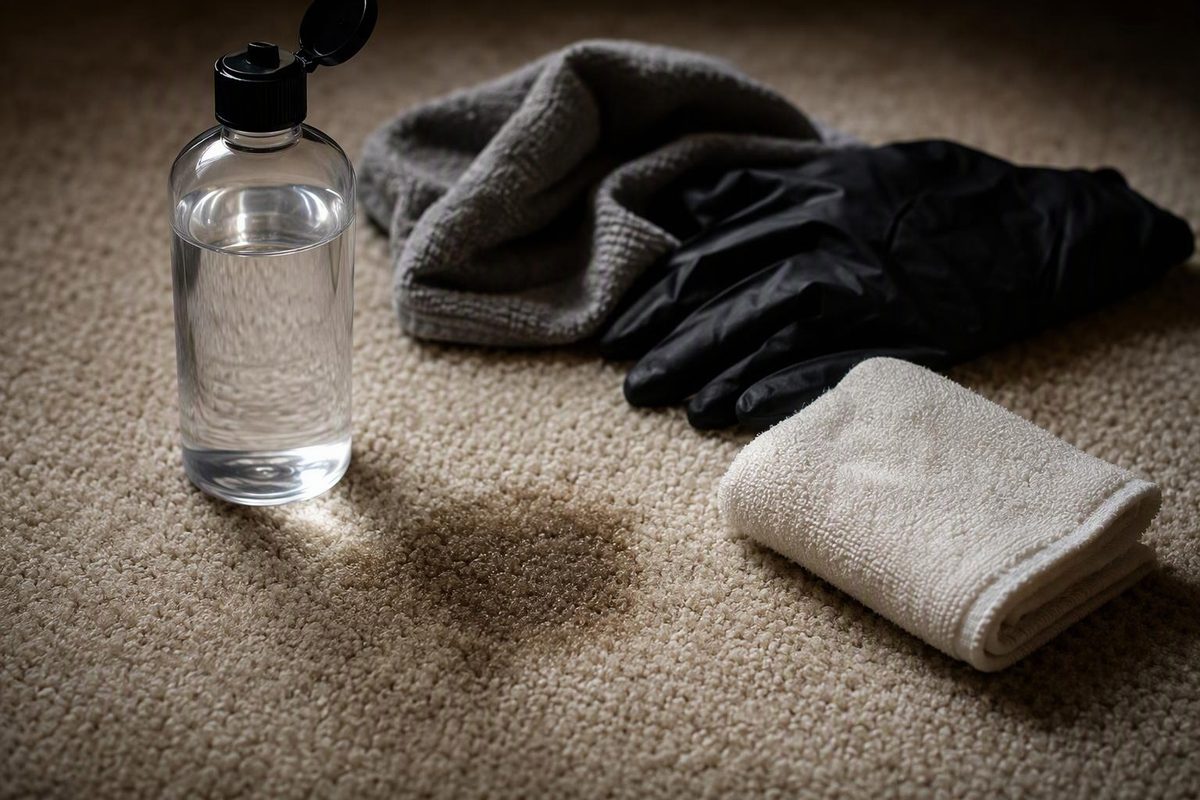
Plain, uncolored 70% isopropyl alcohol is unlikely to leave a colored stain of its own, but it can still leave carpet lighter, darker or ringed. The solvent may move carpet dye, spread the original stain or carry soil toward the edge of the wet area. Check the bottle for additives, blot instead of scrubbing, avoid soaking the carpet and wait until it is completely dry before deciding whether a permanent mark remains.
Choose the product, situation and carpet type to see the safest next step.
Carpet Treatment Check
Select the facts you know. If a label or fiber is unknown, keep that option selected.
Read the bottle before using more product
For a spill from an unknown formula, absorb the liquid and use only a restrained water-dampened blot. Do not use the product as a spot remover until its ingredients are known.
- Remove ignition sources and ventilate.
- Blot with dry white towels; do not scrub.
- Lightly blot with a cool-water-dampened cloth, then blot dry.
- Wait until the carpet is fully dry before judging the mark.
Source note: Recommendations reflect the cited CRI stain guidance, the cited carpet-care guide and safety information for a representative 70% isopropanol product.
Check the Bottle Before Treating the Carpet
“Rubbing alcohol” is not one uniform formula. One representative 70% product contains isopropyl alcohol and deionized water, but other products may contain fragrance, dye, wintergreen or additional ingredients. Do not use a product with those additives as a carpet spot remover.
The distinction matters even when the liquid looks clear. Plain 70% isopropyl alcohol and a scented or otherwise modified rubbing-alcohol product should not be treated as interchangeable. If the ingredient list is unclear, use the spill-cleanup method below rather than applying more of the product to a stain.
Also separate two different situations:
- If rubbing alcohol was accidentally spilled, the immediate task is to absorb it, limit the wet area and remove remaining residue without oversaturating the carpet.
- If you are considering alcohol as a stain remover, use it only for a stain and carpet type for which the method is appropriate. The supported household use described here is targeted treatment of ballpoint ink with 70% isopropyl alcohol.
A bottle being suitable for an ink-removal attempt does not mean it should be poured onto carpet. The amount and application method remain important because excess liquid can spread dissolved material into a larger area or reach deeper layers that dry more slowly.
Blot an Accidental Spill Before Adding Any Cleaner
Begin with safety rather than stain treatment. Remove flames, sparks, cigarettes and operating heaters from the area, and provide ventilation while the carpet is wet. A safety data sheet for a 70% isopropanol product classifies both its liquid and vapor as flammable and calls for adequate ventilation (VWR safety data sheet). Do not use a heater to speed drying.
Blot the spill with dry white towels. Press the towel onto the wet area, lift it, and move to a clean section before pressing again. Replace the towel when it becomes damp. A white towel makes transferred carpet color or soil easier to see.
Do not scrub. The Carpet and Rug Institute (CRI) recommends blotting because scrubbing can roughen carpet fibers and push a spot farther into them (CRI carpet stain guidance). Scrubbing also makes later diagnosis harder: a fuzzy patch may then reflect pile distortion rather than a remaining chemical residue.
Once the towels are no longer picking up much liquid, lightly dampen a fresh white cloth with cool water and blot the affected area. This is a controlled rinse, not a flush. Do not pour water onto the carpet. CRI recommends plain water for rinsing cleaner residue but warns against overwetting.
Press another dry towel over the area after rinsing. Change towels as they become damp, then run a fan across the carpet. Airflow is preferable to direct heat because the product is flammable while wet and because heating one part of the carpet is not part of the recommended treatment.
Leave the area alone until it is fully dry. Damp carpet normally appears darker, so judging it too soon can lead to unnecessary repeat cleaning. Adding alcohol, water or spot cleaner before the first wet area has dried may enlarge the affected zone and make a ring more likely.
Use Carpet Cleaner Only if Dry Residue Remains
If the dry carpet is darker, slightly stiff or tacky, residue or remaining soil is more likely than immediate color loss. Use only a spot cleaner approved by the carpet manufacturer. Apply the cleaner to a white cloth rather than pouring it directly onto the carpet, and work with a small amount.
Blot the residue without rubbing. Follow with a separate cloth lightly dampened with cool water, then press with dry towels and provide airflow again. A carpet manufacturer’s care guide likewise directs users to pretest cleaners, avoid saturation and never apply solvent directly to carpet (Beaulieu carpet care guide).
Do not layer several products over the same mark. Different cleaners can leave their own residues, and a larger wet area makes it harder to tell whether the remaining appearance comes from the original spill, moved soil, cleaner residue or carpet color change. Use one cleaner at a time and follow its label.
If the carpet manufacturer does not permit the cleaner, or if you cannot identify the carpet material, stop rather than improvising. Valuable, handmade, antique, wool, silk and unknown-fiber carpets or rugs warrant the maker’s instructions or a cleaner qualified for that material.
Read the Mark Only After the Carpet Dries
Inspect the fully dry area in daylight and from more than one direction. Carpet pile reflects light differently depending on its direction, so a disturbed patch can appear light from one side and dark from another. Compare the texture as well as the color.
A Dark or Slightly Stiff Patch Suggests Residue
A darker area that also feels slightly stiff is more consistent with residue or remaining soil than with lost color. Use the manufacturer-approved cleaner sparingly, rinse by blotting with a water-dampened cloth, and dry the area thoroughly.
Do not assume that a darker wet patch needs additional treatment. If it has not dried fully, wait. The useful comparison is between the treated area and surrounding dry carpet after moisture is no longer affecting the appearance.
A Lighter Patch May Be Color Loss
Stop cleaning if the dry carpet is lighter but its texture otherwise feels normal. Check the white towels used during treatment. Visible carpet color on them is evidence that dye may have moved.
More solvent will not restore missing color. It may enlarge the light area or move additional dye. A carpet cleaner or color-repair specialist can assess whether the appearance is color loss and whether correction is practical; the available sources do not provide a universal repair method or cost.
A Fuzzy or Rough Patch Points to Pile Damage
If the area looks fuzzy or feels rough, scrubbing may have distorted the pile. Do not brush, rub or repeatedly work the fibers in an attempt to blend the patch. Let the area remain dry and seek professional assessment if the texture difference is conspicuous.
This is why blotting technique matters from the first step. Once rubbing has changed the surface texture, additional stain treatment cannot reliably distinguish a cleaning problem from physical distortion.
A Spot That Returns May Be Wicking
A mark that disappears while wet but returns after drying can indicate that material from lower in the pile is moving upward as the area dries. Repeated soaking can draw up more material and enlarge the visible boundary.
Stop flooding or repeatedly rinsing the area. Allow it to dry between restrained blotting attempts. The same recurring pattern is covered in the guide to wick-back and recurring carpet spots.
Wrinkles or Separation Require Professional Attention
Stop adding liquid if the carpet becomes wrinkled or loose, or if separation appears near an edge or seam. These conditions are not a reason to apply more solvent or water. Contact a carpet professional and describe what was spilled, the product concentration if known, and what treatment has already been used.
Use 70% Isopropyl Alcohol Only for a Suitable Stain
Rubbing alcohol is a targeted solvent, not an all-purpose carpet cleaner. CRI recommends 70% isopropyl alcohol for ballpoint ink, applied to a cloth or paper towel rather than poured onto the spot (CRI ink-removal guidance). That recommendation does not establish alcohol as the right treatment for every ink, every carpet or every product labeled rubbing alcohol.
Marker needs a separate diagnosis because washable and permanent inks require different approaches. Identify the ink before treating it; the relevant methods are covered in how to get marker out of carpet.
Do not reach automatically for alcohol on food, blood, urine or an unidentified stain. The draft sources provide no basis for treating those unrelated stains with this solvent. Identify the material first and use a method matched to it.
Patch-Test Before Treating Ballpoint Ink
Check the carpet’s care instructions before using alcohol. If they prohibit solvent treatment, follow those instructions. If alcohol is permitted, test a hidden area with a white cloth lightly dampened with plain 70% isopropyl alcohol.
Let the test area dry completely. A wet test does not show the final color. Stop if carpet color transfers to the cloth, the pile changes, or the dry test area becomes lighter than the surrounding carpet.
A successful hidden test reduces uncertainty but does not justify soaking the visible stain. The inked area may contain more transferable material, and the visible location may be harder to rinse and dry than the test spot.
Dab Ballpoint Ink From the Outside In
Put a small amount of 70% isopropyl alcohol on a fresh white cloth. Do not pour it onto the carpet. Dab the outside edge of the ballpoint ink mark first, then work inward. Starting at the edge helps limit outward spread while the ink transfers.
Rotate the cloth frequently so a clean section meets the carpet. Otherwise, the cloth can place collected ink back onto the fibers. Keep the motion vertical and controlled rather than rubbing across the pile.
Stop when ink no longer transfers. More alcohol does not guarantee more removal, and repeated wetting can expand the treated area. A faint remaining mark is not a reason to saturate the backing or continue after the carpet has stopped releasing ink.
Blot the treated area with a separate cloth lightly dampened with cool water. Then press with dry towels and ventilate until the carpet is fully dry. Inspect the result only after drying, using the same checks for darkness, lightening, roughness or a returning ring.
If the stain remains after a careful attempt, use the carpet manufacturer’s approved procedure or consult a qualified cleaner. Report that 70% isopropyl alcohol was used, whether ink or carpet color appeared on the towel, and whether the mark changed after drying. Those details are more useful than repeating the solvent treatment without a clear endpoint.