 StainList
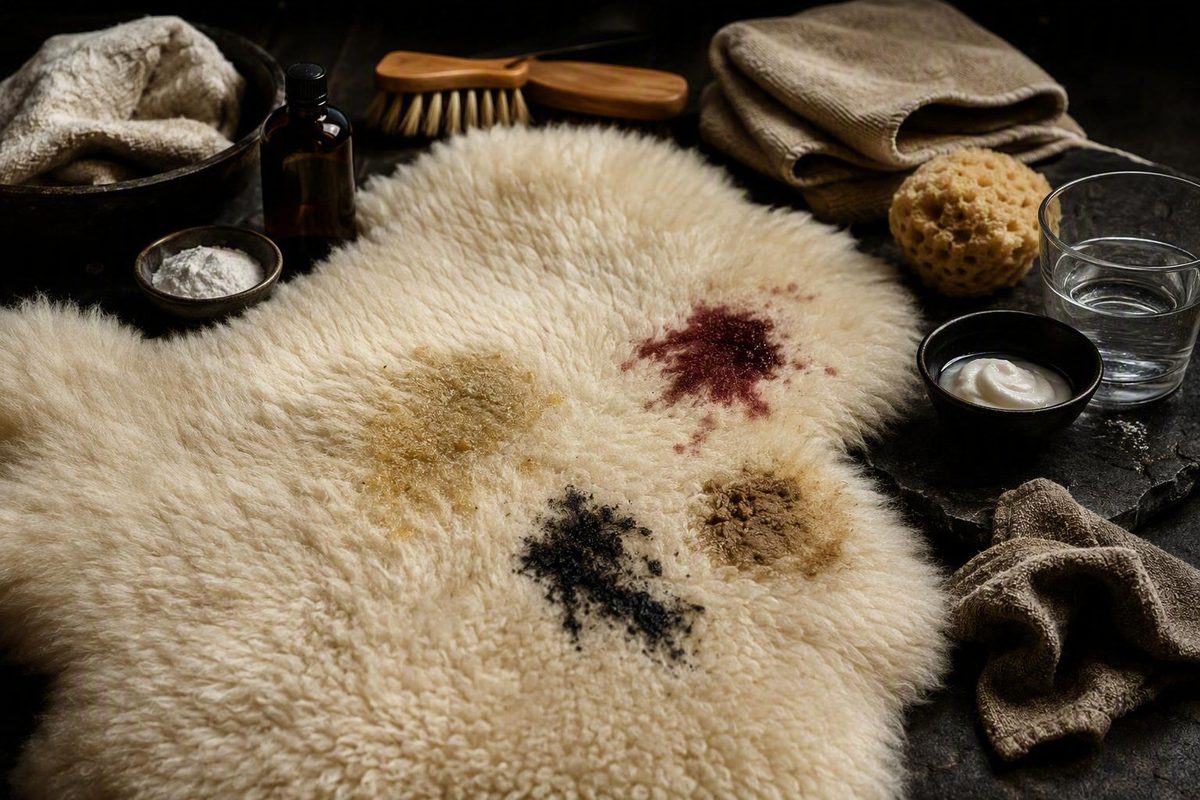
A genuine sheepskin rug is not simply a wool rug. It consists of wool attached to a leather hide, and those materials do not always tolerate the same moisture, chemicals, agitation, or heat. A treatment that cleans the fleece can still leave the backing stiff, shrunken, stretched, discolored, or misshapen.
The safest approach is a risk ladder:
- Identify the rug and record its care instructions.
- Begin with shaking, shaded airing, and gentle vacuuming.
- Spot-clean with as little moisture as practical.
- Wash the whole rug only when its own label expressly permits it.
- Support, reshape, and dry a wet hide naturally without heat.
- Stop and consult a specialist when the construction is uncertain or damage appears.
Published guidance conflicts over machine washing, spinning, detergent choice, and brushing while damp. Some suppliers permit these practices for selected products, while others warn that immersion or mechanical handling can permanently alter the leather. The individual rug’s label must therefore take priority over any universal recipe.
The practical guidance below reflects a cautious synthesis of manufacturer and retailer care instructions. The supplied evidence does not include independent textile-conservation testing that establishes one method as safe for every tannage, dye, finish, age, or construction. Where product instructions are absent or uncertain, the recommendations deliberately favor less moisture and less intervention.
Start With the Care Label and the Rug’s Construction
Before using water or cleaner, determine what you own. Genuine sheepskin has wool fibers attached to leather; synthetic faux sheepskin has a different construction and must be cleaned according to its own label. Use the care label, purchase record, seller documentation, or manufacturer confirmation instead.
That distinction matters because cleaning must protect both the visible pile and everything beneath it. Heat, harsh detergent, excessive moisture, or agitation may affect the wool, leather, dye, finish, seams, lining, or adhesive differently. Manufacturer instructions take priority because tanning and finishing methods can impose product-specific restrictions. Jacobs & Dalton explains the central wool-and-leather problem and advises checking the product label before cleaning.
Photograph or transcribe the care label before starting. If the print later fades, the rug changes hands, or a professional needs to assess it, that record may be the only product-specific information available. Check for:
- Washable, hand-wash, machine-wash, spot-clean-only, or dry-clean-only wording
- Water-temperature and cycle restrictions
- Instructions about rinsing or mechanical spinning
- Whether the rug is natural, dyed, printed, or bleached
- A leather, suede, fabric, or lined backing
- Several pelts joined together
- Decorative seams, bindings, inserts, or adhesives
- A specified cleaner or prohibited ingredients
- Drying, reshaping, and brushing directions
Do not infer washability from the rug being small, white, ivory, natural-looking, undyed, or leather-backed. Suppliers sometimes permit washing for selected rugs while restricting it for superficially similar products. Age and condition also matter: an older, brittle, creased, repaired, previously shrunken, or already stiff hide is a poorer candidate for wet cleaning than a sound rug whose label expressly permits washing.
Use this matrix as a conservative screening tool, not as a substitute for the label:
| Rug type or condition | Conservative approach |
|---|---|
| Label expressly permits washing | Cautious hand or machine washing may be possible within the stated instructions |
| Synthetic faux sheepskin | Follow its own textile-care label; do not automatically apply leather-hide treatments |
| Dyed or printed | Test for color transfer; favor localized cleaning or specialist assessment |
| Suede-backed | Avoid immersion unless the product instructions expressly permit it |
| Fabric-backed or lined | Do not assume the backing, adhesive, or lining is washable |
| Joined-pelt or oversized | Prefer specialist assessment because wet weight can strain joins and distort panels |
| Dry-clean-only | Do not wash; find a cleaner experienced with wool attached to hide |
| Aged, stiff, cracked, repaired, or distorted | Avoid immersion and seek an assessment |
| No readable label or unknown construction | Use dry maintenance and minimal-moisture spot cleaning only |
Construction-specific guidance supports this cautious distinction. Fibre by Auskin says products with cotton or other backing materials are generally unsuitable for hand or machine washing, treats dyed products more cautiously because colors may bleed, and warns that washing can alter both the wool fibers and leather pelt. Its care guide also advises plain-suction vacuuming and avoiding over-wetting.
If the label is missing, unreadable, or inconsistent with generic online advice, do not treat uncertainty as permission to immerse the rug. Default to shaking, low-suction vacuuming, dry shaded airing, and cautious localized cleaning. Contact the manufacturer if it can be identified, or ask a cleaner experienced with wool-on-hide, shearling, or leather to assess the rug’s construction and condition.
Before applying any cleaner broadly, test a hidden area:
- Put a clean white towel behind or beneath the test area if practical.
- Apply the smallest useful quantity of properly diluted cleaner.
- Blot rather than scrub.
- Remove residue with a separate, barely damp white cloth.
- Let the area dry completely.
- Compare its color, feel, loft, shape, and backing flexibility with the untreated area.
Stop immediately if dye appears on the cloth, the wool becomes coarse or felted, the backing stiffens, the rug distorts, or discoloration spreads. A wet patch may temporarily look darker, so assess final color after complete drying—but do not continue treatment while waiting if active dye transfer or deformation is already visible.
Use a Low-Risk Maintenance Routine to Delay Washing
Routine maintenance should remove loose debris and reduce tangling without repeatedly wetting the hide. There is no reliable schedule for every rug. Foot traffic, pets, children, fleece length, indoor humidity, tracked-in grit, visible flattening, and odor all affect how often attention is needed.
A practical sequence is:
- Shake the dry rug outdoors. Hold it securely and shake without sharply snapping fragile seams or joined sections.
- Air it in dry shade. Allow air to reach the fleece and backing while keeping the rug away from damp ground.
- Vacuum lightly. Work in the direction of the fleece with a plain suction nozzle.
- Brush only where appropriate. Long fleece may benefit from occasional detangling; short fleece often does not.
- Rotate the rug. Change its orientation periodically to distribute wear and reduce constant sunlight exposure on one area.
Some retailer guides suggest vacuuming weekly or every one to two weeks, but this is a starting point rather than a universal rule. The Icelandic Store gives that range for its long-fleece products and warns against over-brushing. Reduce the frequency or suction if fibers are being pulled, lifted aggressively, or left frizzy. Its Icelandic sheepskin guide describes gentle brushing in the direction of growth.
The supplied care guides consistently advise using a standard plain-suction nozzle rather than a rotating head. Avoid turbo, revolving-brush, and beater-bar attachments because their mechanical action can catch or frizz the wool. Do not compensate for weak suction by grinding the nozzle repeatedly over one spot.
Handle different fleece lengths differently:
- Long wool: After shaking and vacuuming, separate obvious tangles in the direction of growth. If the manufacturer permits it, use a suitable carding or slicker-style brush with light pressure and short passes.
- Short wool: Shaking and plain-suction vacuuming are often enough. Unnecessary brushing can change the uniform appearance of the pile.
- Fragile or actively shedding wool: Stop brushing or vacuuming if fibers release readily. Continued shedding, loose sections, or emerging bare areas justify specialist assessment.
Over-brushing is not harmless. The objective is to separate and align the fleece—not to force every natural curl into a straight, uniformly fluffy finish.
Rotate the rug where practical, especially if one edge receives most of the traffic. Keep it away from constant direct sunlight, radiators, heated floor vents, and other heat sources. Air it only under dry, shaded conditions; placing it outdoors in damp weather or returning it to a humid storage area can leave moisture in the hide.
Follow a First-Minutes Spill and Spot-Cleaning Protocol
A quick response helps, but forceful cleaning can make a spill worse. The immediate objective is to remove material from the fleece while limiting spread and preventing unnecessary saturation of the backing.
For solids or semi-solids
- Lift material upward with a spoon, dull knife, or another blunt edge.
- Work from the surface rather than scraping through the fleece.
- Do not press, grind, or massage residue toward the backing.
- Blot any remaining moisture after the bulk has been removed.
For liquids
- Place clean white towels over the spill and press gently.
- Replace the towel as it becomes wet.
- Work from the outer edge toward the center.
- Keep treatment confined to the affected area.
Fibre by Auskin similarly advises lifting solids without forcing them deeper, blotting liquids promptly, and using water sparingly rather than rubbing or over-wetting the product. Its spill instructions distinguish between solid and liquid removal.
After absorbing free liquid, begin with a clean cloth lightly dampened with label-approved cool or lukewarm water. Blot from the outside inward. If water is insufficient and the care instructions permit a cleaning solution, apply a small amount of properly diluted cleaner explicitly compatible with both wool and sheepskin leather.
Remove the cleaner afterward with a second cloth lightly dampened with clean water. Use as little water as practical and continue blotting until no obvious cleaner remains. This is a conservative precaution intended to avoid leaving a noticeable residue in the pile.
Then:
- Press the area between dry, absorbent towels.
- Support and flatten any damp section of backing.
- Gently return a puckered area toward its original shape.
- Dry it in shade with steady, unheated airflow.
- Keep the area out of use until both fleece and backing feel fully dry.
Do not improvise a universal formula for unknown, oily, strongly colored, biological, or deeply penetrated stains. Treatments intended for ordinary carpet, upholstery, washable fabric, detached wool, grease, ink, or red wine cannot automatically be transferred to wool attached to leather. A chemical tolerated by the visible fleece may affect the tanning, dye, finish, or backing underneath.
Stop home treatment if:
- Dye appears on the towel
- The wool changes texture
- The stain spreads
- The backing becomes saturated
- The area develops a pronounced boundary after drying
- The hide becomes noticeably stiffer
- The odor suggests that urine, vomit, mildew, or another contaminant reached the backing
Treat penetration into the hide as a conservative escalation threshold. Surface cleaning may improve appearance without reaching material held deeper in the rug, while repeated rewetting can increase the risk of distortion. Pause treatment and seek advice from a cleaner experienced with sheepskin or shearling.
Choose a Cleaner That Is Safe for Wool and the Hide
“Wool-safe” is necessary but not always sufficient. A cleaner must also be compatible with the leather, tannage, dye, finish, backing, and the rug’s care instructions. A detergent intended for a washable wool sweater has not automatically been shown to be suitable for an attached hide.
When wet cleaning is permitted, favor a mild liquid product that explicitly states suitability for sheepskin or wool-on-hide. Check that the cleaner and rug instructions agree about application method, concentration, water temperature, rinsing, and drying. If they conflict, ask the rug manufacturer rather than combining or averaging the directions.
The supplied product guides broadly advise avoiding:
- Chlorine bleach and bleaching cleaners
- Biological or enzyme detergents
- Fabric softener
- Strongly alkaline or otherwise harsh cleaners
- Optical brighteners
- Regular laundry detergent
- Unapproved household stain removers
- Solvent mixtures taken from generic carpet advice
- Hot water
Kiwi Sheepskins warns that some products sold as wool wash contain enzymes and says to check the rug label because certain sheepskins are dry-clean-only. Where washing is allowed, its guidance calls for a mild, enzyme-free, bleach-free product and cool or lukewarm water. See its detergent and label cautions.
Some suppliers recommend diluted dishwashing liquid for selected products. That does not establish dish soap as universally compatible with every tanning and finishing system. Use it only if the rug’s manufacturer expressly approves it. The same limitation applies to proprietary wool washes: familiarity with a brand does not override the care label.
Do not use one universal dilution or temperature. Published limits vary, and a compatible concentration depends on the particular cleaner. Measure the detergent according to directions that apply to both the cleaner and the rug, and use cool or lukewarm water within the care label’s stated limit.
Common home remedies are not strong default choices. The supplied evidence does not establish baking soda, baking powder, cornstarch, essential oils, dryer sheets, or fragrance sprays as residue-free and compatible with every wool, dye, leather, and finish. Avoid treating them as universal deodorizing or stain-removal methods.
For every cleaner:
- Patch-test a hidden area.
- Use the smallest effective amount.
- Keep the treatment localized.
- Remove residue with minimal water.
- Stop if color, texture, shape, or backing flexibility changes.
More chemical action does not necessarily mean better cleaning. Every additional application also increases the hide’s exposure to moisture and cleaner.
Decide Whether to Spot-Clean, Hand-Wash, Machine-Wash, or Call a Professional
Choose the least invasive method reasonably capable of addressing the problem:
- Shake and air the rug.
- Vacuum with plain suction or brush appropriately.
- Spot-clean with minimal moisture.
- Rinse only the affected section if the label allows it.
- Wash the whole rug only with explicit label approval.
- Refer uncertain, damaged, or high-risk rugs to a specialist.
Spot cleaning
Spot cleaning is generally the preferred home method for isolated spills, small marks, and lightly soiled areas. It limits moisture, detergent, and mechanical stress to one part of the rug.
It may not be sufficient when contamination has penetrated the hide, soil covers much of the rug, or repeated local treatment would produce numerous overlapping wet patches.
Localized rinsing
A brief localized rinse may help remove compatible cleaner residue or a water-soluble mark, but only when the care instructions permit water. Support the wet section, use the lowest practical volume, and press it with towels afterward. Do not wet the entire rug merely because one area needs rinsing.
Hand washing
Hand washing is often described as gentler than machine washing because it permits closer control over support and agitation. It still immerses the hide, however, and can result in stiffness, shrinkage, stretching, distortion, matting, color loss, or a changed wool texture.
If the label expressly permits a full hand wash:
- Use cool or label-approved lukewarm water.
- Add only the measured compatible cleaner.
- Lower the rug into the water while supporting its weight.
- Use minimal movement and do not rub or scrub.
- Rinse thoroughly without pulling the rug by an edge.
- Press out water with towels.
- Never twist or wring.
Machine washing
There is no universal yes-or-no answer. Some sellers permit a delicate machine cycle for selected rugs; others discourage machine washing because immersion and mechanical action may harden or deform the leather backing. SheepskinShop, for example, permits machine washing for its own rugs under specified conditions while warning that submersion may harden the leather. Its conditional instructions illustrate why permission must come from the individual product label.
Machine-wash only if the individual rug label expressly identifies the rug as machine-washable. Do not infer permission from size, color, origin, natural appearance, or backing type. If the label permits it:
- Follow the stated machine type, cycle, temperature, and load limits.
- Use only the approved cleaner and quantity.
- Wash separately if instructed.
- Use the minimum permitted agitation.
- Follow the stated rinsing procedure.
- Use a spin cycle only if the label specifically allows it.
Towel pressing is the more conservative way to remove excess water. Some care guides recommend spinning for their washable products, while others warn against the strain or creasing that mechanical extraction may impose on a saturated hide. Follow the rug’s own directions.
Why support matters
A saturated rug becomes much heavier. Lifting it by one corner concentrates that weight on the wet hide, seams, and joined sections, increasing the risk of stretching or tearing. Support the rug from underneath with a clean sheet, a suitable container, or another stable surface when moving it.
This precaution is particularly important for oversized rugs and rugs assembled from multiple pelts. Uneven support can place different loads on individual panels and seams.
Poor candidates for DIY washing
Refer the rug rather than immersing it if it is:
- Marked dry-clean-only
- Dyed or transferring color
- Suede-backed, fabric-backed, or lined
- Oversized or made from joined pelts
- Valuable, fragile, aged, brittle, or repaired
- Heavily or extensively soiled
- Affected by oil or biological contamination
- Already stiff, shrunken, stretched, creased, or misshapen
- Severely matted or actively shedding
- Missing a readable care label
Dry cleaning is also product-specific. “Dry-clean-only” does not mean that any ordinary garment or rug-cleaning process is suitable. Look for direct experience with leather, shearling, or wool attached to hide, and give the cleaner the original care information.
Dry and Reshape the Rug Without Heat Damage
Drying is part of the cleaning process, not an afterthought. A heavy wet hide can stretch under its own weight, while rapid or heated drying can leave the leather harder or smaller.
First remove water conservatively:
- Keep the rug supported.
- Press it between clean, absorbent towels.
- Replace saturated towels and repeat.
- Do not twist, wring, or pull the rug.
- Use mechanical spinning only if the label expressly permits it.
Move a saturated rug with support beneath it rather than lifting it by an edge or by the fleece. A clean sheet can serve as a sling for a manageable rug; a large rug may require a suitable container or broad support so its weight remains distributed.
Dry flat when practical on a clean, colorfast surface arranged to permit airflow. If the label allows line drying, use a strong setup that spreads the load rather than concentrating it on one narrow fold or a few clips. Kiwi Sheepskins notes that large wet rugs become very heavy and may need several supported lines to reduce hide stretching. Its guidance also calls for damp reshaping and drying away from direct sunlight and artificial heat.
While the backing remains damp, gently return it toward its original dimensions. Work evenly around the perimeter rather than pulling one side. Smooth creases and watch joined sections for unequal tension. Reshaping means restoring alignment with low force—not stretching the rug beyond its former size.
Provide steady airflow in a dry, shaded location. Both fleece and leather must dry completely. Reposition the supported rug if its instructions permit and doing so exposes damp areas to airflow, but do not fold wet sections against one another.
Do not use:
- A tumble dryer
- Radiators or heaters
- A hairdryer
- Forced hot air
- An iron
- Hot water
- Direct sunlight
The supplied care guides consistently warn that heat can harden or shrink the hide, while direct sunlight may contribute to fading or yellowing. Drying may take an extended period depending on the rug’s size, fleece density, room humidity, and airflow. Do not assume the hide is dry merely because the tips of the fleece feel dry.
Brushing instructions conflict. Some suppliers recommend brushing long wool while damp and again when dry; others advise against brushing wet wool. Follow the rug’s label. If damp brushing is not expressly permitted, use only minimal hand separation to prevent severe clumping and leave the final gentle brushing until the rug is dry.
Stop DIY restoration if the rug:
- Becomes markedly stiff
- Shrinks or develops deep creases
- Pulls out of shape
- Shows strained or stretched joins
- Remains damp-smelling despite dry, shaded, well-ventilated conditions
- Develops color migration
- Begins tearing or shedding significantly during handling
Do not repeatedly rewet a damaged rug in an attempt to correct the result. Further immersion may increase distortion without reversing the original change.
Troubleshoot Matting, Odor, Yellowing, and a Stiff Backing
Not every visible change is a removable stain. First distinguish among temporary flattening, trapped moisture, discoloration, felting, and damage to the leather.
Flattened or tangled fleece
For ordinary flattened long wool:
- Shake the dry rug.
- Vacuum lightly with plain suction.
- Separate the ends of tangles with your fingers.
- Brush gently in the direction of growth if the care instructions allow it.
- Stop when the pile is separated rather than pursuing a perfectly straight finish.
Short fleece usually needs little or no brushing. If the wool has fused into dense, felt-like areas instead of merely lying flat, harder brushing may pull fibers without restoring the original pile. Severe matting is better assessed by a specialist.
Odor
First determine whether the smell appears superficial or moisture-related. Air the rug in dry shade with unheated airflow reaching both sides. Check the center, edges, seams, and leather backing—not only the fleece tips—to confirm complete drying.
Avoid masking the problem with fragrance spray, essential oils, or dryer sheets. Do not put the rug in a tumble dryer, and do not assume deodorizing powders are compatible with every sheepskin.
A persistent damp or musty smell may indicate that moisture remains in the hide. Urine-like, biological, or contamination-related odor may indicate penetration beyond the wool surface. These are reasonable points to stop repeated home treatment and request professional assessment.
Yellowing and fading
Move the rug out of direct sunlight to limit continuing exposure. Prolonged sunlight can fade dyed sheepskin and contribute to yellowing or color reversion in pale rugs. Wilson & Dorset warns that yellowing associated with age or sunlight may not be fully reversible, even with professional treatment. Its guide distinguishes ordinary surface soil from potentially permanent color change.
Do not use bleach, optical brighteners, peroxide mixtures, or generic white-rug treatments. A yellow cast may reflect age, ultraviolet exposure, unsuitable cleaner, or a change in the wool or hide rather than removable surface dirt.
Stiff backing
A firmer feel after wetting is not a reason to beat, oil, condition, aggressively flex, or repeatedly rewet the hide. Without knowing the tannage and condition, those interventions cannot be assumed safe. Marked hardness, shrinkage, cracking, or board-like creasing requires specialist assessment.
Felting, shrinkage, dye loss, hide deformation, and tanning damage may be permanent. Professional treatment may improve appearance or handling, but restoration to the original condition cannot be promised.
| Warning sign | Immediate response | When to escalate |
|---|---|---|
| Dye transfers to a white cloth | Stop applying cleaner and moisture; blot gently | Immediately, especially for dyed or valuable rugs |
| Persistent damp or musty odor | Use dry, shaded conditions with steady unheated airflow and check the hide | If odor remains after complete drying or contamination is suspected |
| Severe matting or felted patches | Stop aggressive brushing | If gentle dry separation does not work |
| Hide becomes stiff | Stop heat, forceful flexing, and rewetting | If stiffness is marked or accompanied by cracking |
| Rug shrinks or distorts | Support it flat and avoid forceful pulling | If gentle damp reshaping does not restore alignment |
| Joined sections stretch | Lay the rug flat with full support | Immediately; avoid unsupported hanging |
| Rug will not dry fully | Move it to a dry, shaded, well-ventilated location | If it remains damp-smelling or tacky |
| Wool sheds or pile texture changes | Stop vacuuming and brushing | If shedding continues or bare areas develop |
The useful distinction is between pile arrangement and material damage. Flattened dry fibers can often be lifted. Felted wool, migrated dye, shrunken leather, and degraded joins may not be reversible.
Know When to Use a Specialist and How to Store the Rug
Choose a cleaner experienced specifically with leather, shearling, or wool-on-hide when the rug has:
- Unknown construction or missing care instructions
- Dry-clean-only wording
- A suede, lined, or fabric backing
- Severe, oily, or strongly colored stains
- Urine, vomit, mold, or other biological contamination
- Extensive embedded soil
- Persistent odor
- Dye transfer
- Stiffness, shrinkage, or distortion
- Heavy matting or active shedding
- High monetary or sentimental value
- Oversized dimensions or joined pelts
Large and joined-pelt rugs deserve extra caution even if their materials might otherwise be washable. Their wet weight makes home handling more difficult, and uneven support can stretch seams or distort individual panels.
Ask a prospective cleaner:
- Do you regularly clean wool that remains attached to leather?
- Have you handled shearling or this type of backing before?
- Will you test dye stability first?
- How will you assess or account for the tannage and finish?
- How will the wet rug be supported, reshaped, and dried?
- What risks arise from its age, seams, backing, or existing damage?
- Will you decline treatment if testing indicates excessive risk?
- Which changes may be permanent?
Do not accept a guarantee that every stain, odor, yellow cast, matted patch, or hardened area will disappear. Professional treatment can reduce handling risk and may improve the rug, but it cannot necessarily reverse felting, dye loss, shrinkage, ultraviolet change, or tanning damage.
Before storage, clean the rug only as much as necessary and ensure both fleece and hide are completely dry. Trapping moisture presents a greater concern than storing a rug with a minor harmless appearance mark.
Store it:
- In a cool, dry, ventilated location
- Away from direct sunlight, radiators, and hot pipes
- In a breathable cotton or cloth cover
- Without heavy objects compressing it
- Without sharp, permanent folds
Avoid sealed plastic during prolonged storage because it can trap residual moisture or condensation. SheepskinShop recommends breathable cloth storage and protection from prolonged sunlight and heated air. Its care instructions cover both storage and environmental precautions.
Inspect the rug periodically for damp odor, pests, distortion, compressed creases, or color change. If it is rolled, change the roll position occasionally without tightly compressing it. Before returning the rug to use, air it in dry shade and restore the pile gently according to its fleece length.
Frequently Asked Questions
Can you vacuum a sheepskin rug?
Yes, unless the care label prohibits it. Use low or ordinary plain suction, work in the direction of the fleece, and fit a standard nozzle without a rotating brush. Avoid turbo, revolving-brush, and beater-bar heads because supplier care guides warn that they can catch, disturb, or frizz the wool. This sheepskin care guide likewise recommends gentle suction without a rotating head.
Vacuum according to need rather than a rigid schedule. Reduce the frequency or suction if fibers are being pulled or the pile is becoming rough. Shake the rug first when practical, and address long tangles with careful hand separation or label-approved brushing rather than repeated vacuum passes.
Can you put a sheepskin rug in the washing machine?
Only if the individual care label expressly permits machine washing. Retailer advice conflicts: some allow a delicate cycle for selected rugs, while others warn that immersion may permanently harden or deform the leather. Rug Traders explicitly describes this conflict and notes the risk of irreparable hide damage. Its guide treats machine washing as a disputed, higher-risk method.
If machine washing is permitted, follow the exact cycle, water temperature, cleaner, load, rinsing, and extraction instructions. Do not use a spin cycle unless the label approves it. Otherwise, use localized cleaning or consult a wool-on-hide specialist.
What detergent is safe for a sheepskin rug?
Use a mild liquid cleaner explicitly approved for the particular rug and compatible with both wool and sheepskin leather. “Wool-safe” by itself does not establish suitability for the hide or its tannage.
Avoid bleach, biological enzymes, fabric softener, optical brighteners, harsh or strongly alkaline cleaners, ordinary laundry detergent, and unapproved stain removers. SheepskinTown, for example, specifies bleach- and enzyme-free cleaner for its rugs and limits its full hand-washing instructions to selected natural ivory products. Its product-specific guidance shows why detergent approval should not be generalized.
Do not assume dishwashing liquid or a household remedy is safe. Follow compatible rug and cleaner directions for dilution and water temperature, and patch-test before broader use.
How do you make a sheepskin rug fluffy again?
For dry, flattened long fleece, shake the rug outdoors, vacuum gently with plain suction, separate tangles with your fingers, and brush lightly in the direction of growth if the care label allows it. Stop once the fibers are separated. Short fleece often needs no brushing.
After washing, follow the label because suppliers disagree about brushing while damp. If damp brushing is not expressly permitted, minimize tension during drying and complete any gentle final brushing after the rug is fully dry. Dense felting may not be reversible at home. The Icelandic Store’s guidance recommends gentle brushing for long tangled fleece while warning against over-brushing.
Can a yellowed or stiff sheepskin rug be restored?
Sometimes its appearance or handling can be improved, but restoration is not guaranteed. Ordinary pile flattening may respond to shaking and gentle brushing, while age- or sunlight-related yellowing, felting, shrinkage, dye loss, and hide deformation may be permanent.
Do not bleach a yellowed rug or beat, oil, aggressively flex, or repeatedly rewet a stiff backing. Remove it from sunlight and heat, allow any remaining moisture to dry with steady unheated airflow, and consult a leather or shearling specialist if the hide is board-like, cracked, shrunken, or misshapen. Wilson & Dorset notes that age- or sunlight-related yellowing may not be fully reversible.
The safest sheepskin cleaning method is the least invasive one that solves the problem. Follow the label, maintain the rug with shaking, appropriate brushing, shaded airing, and plain-suction vacuuming, and treat spills with minimal moisture. Reserve immersion for rugs expressly labeled washable, support and reshape the wet hide, and dry it naturally without heat. Stop and consult a wool-on-hide specialist when construction is uncertain or when dye transfer, severe staining, persistent odor, stiffness, shrinkage, or distortion appears.